
3.f) Mechanisms of movement
When discussing movement in general, we have seen characteristics and properties of the speed of light or electromagnetic energy.
We have also shown source, meaning, and material support for kinetic energy about mass motion upon the reticular structure of matter or Global Aether.
Supersymmetry breaking occurs with mass when generating a gravitational field. This phenomenon presents two types of effects on the mechanisms of motion:
-
Acceleration of free fall of bodies corresponding to Newton's Law of Universal Gravitation that operates according to Newton's Second Law or proportionality of force, mass and acceleration; keeping in mind the increase of mass with velocity.
The main difference between motion within total symmetry and accelerated movement of free fall is that increment of kinetic energy comes from potential gravitational energy.
-
The second component of the atractis causa or Merlin effect explained in the book Law of Global Gravity, enlightens effect of the curvature of light in gravitational lensing and anomalous precession of orbits of the planets.
Next, we will explain kinetic energy as a direct cause of movement, and the mechanisms of velocity and acceleration of mass, with and without gravity.
Section Movement with gravity studies mechanics of motion of mass with the radial symmetry of gravity, and explains it is like with total symmetry, but with the addition of intrinsic force of gravity.
3.f.1. Physics of movement without gravity
In this section, we analyze mechanics of movement of bodies with mass in a theoretical phase of total symmetry of Global Aether.
Let us look at different situations of mass and kinetic energy regarding motion and acceleration.
Rest
Global mass is mass at rest plus kinetic mass –equivalent mass to kinetic energy–, but in this case, kinetic energy is null.
We are always within a model with Euclidean space, absolute time, and with motion measured within the natural reference system or Global Aether (gravitational - kinetic - mass).
Global Aether is in constant vibration and synchronized with the resonance of mass.
Mass at rest or null movement (System of natural reference) 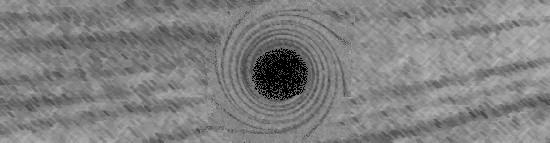
The privileged velocity is zero when mass is at rest within Global Aether –natural system of reference regarding kinetic energy–, and kinetic energy is null. Therefore, there will be a balance in the three-dimensional play of forces in the interaction between Global Aether and the mass, given the total symmetry of Global Aether of our hypothesis.
When there is no movement of the mass in the Global Aether, if the system of reference changes, there would be relative movement, but mass would not have changed, and kinetic energy would still be null. That is, relative motion does not express the underlying physical reality. It is like when one is moving in a car, and the trees appear to move towards the person, and it looks they are getting bigger. Of course, all depends on the definitions and axioms.
-
Mechanisms of linear and uniform motion
After an instant acceleration or acceleration during a specific period, we can outline uniform rectilinear motion.
Now, there is kinetic energy provided by the initial force that produced the acceleration. Mass has deformed, or altered its spatial configuration, once it absorbed energy; so, the mass will have an edgy shape as in the figure. This absorption and spatial deformation of global mass is the essence of kinetic energy.
As a result, the concept of an increase in Einstein's relativistic mass –regardless of its mathematical formalization– is only correct when using in the natural system of reference of movement or Global Aether.
Continuing with the case of total symmetry, the vibration of Global Aether synchronizes with vibration or resonance of mass; given that mass is a slipknot throughout the filaments of Global Aether.
The interaction between moving mass and Global Aether will produce forces due to the Global Aether natural tendency to revert to the state of total symmetry. However, the spatial configuration of mass no longer has the symmetry of the figure of mass at rest; therefore, the play of forces will not give a null resultant initially.
Vibration or internal energy of both the filaments of the mass and Global Aether –red line in the figure– would affect the mass depending on the points and angles of contact. We can analyze in these terms; but, in fact, it is an internal process, because we know mass is the curl of filaments of Global Aether.
Continuing with the analysis, exchange of energy would be bigger on the right side of the visible contact point, so the mass will begin to move towards the left. At the same time, move to the left means an increase in resistance to the movement; this resistance will increase with velocity.
Consequently, the forces will balance themselves out with the mechanism of mass movement, since it increases contact or tension of the filaments in the sense of movement and relaxes contact or tension of the filaments in the opposite side. Keeping in mind total effects are in three-dimensional Euclidean space.
Global Aether Dynamic equilibrium of the elastic forces 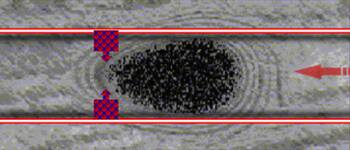
Likewise, as we can see in the figure, the total energy exchange will be null because of the forces –vertical arrows– are opposite. Therefore, when speed balances the energy exchange, it will begin a uniform linear movement in the absence of other forces.
While kinetic energy does not undergo any variation, velocity continues with uniform motion. This type of motion is consistent with Newton's First Law.
On the other hand, movement makes it so that the mass reaches next vibration of the filaments of Global Aether a little earlier than if it were at rest, and so on. In other words, the resonance frequency of mass is greater than in the state of rest.
Therefore, the resonance frequency of mass, increased by the mechanism of movement, is still synchronized with the filaments of Global Aether. That is, movement on Global Aether is the mechanism of balancing the resonance of mass with Global Aether itself, or of its synchronization.
Resonance frequency or vibration of mass has increased with velocity through the Global Aether. It appears that time does not change, unless the current definition of second precisely based on this frequency, as General Relativity proposes.
-
Mechanisms of motion with acceleration
Acceleration within the natural system of reference or Global Aether implies an increase in kinetic energy. This process is similar to the previous case of linear uniform motion regarding change or initial acceleration concerning the state of rest.
The continuous increase of kinetic energy implies greater increase and greater deformation of mass. Likewise, greater velocity implies greater mass resonance to keep synchronization with Global Aether.
Again, in this case, time does not change.
On the contrary, in General Relativity, what governs the relative unit of time is velocity; consequently, the acceleration will change this unit.
With these characteristics of the model about motion and acceleration, it would be immediate to know the size of a Global Aether reticule if it relates directly to the mass resonance frequency.
It is not surprising that maximum speed of mass is the velocity of propagation of longitudinal tension of the kinetic or Global Aether –same as the speed of light. When reaching that speed, the mass will have an energy level related with c², which implies a physical limit between different phases of Global Aether.