
2.a) Newton's First Law, or Law of Inertia
According Wikipedia, Newton's First Law affirms that in absence of external forces, all the bodies remain in their state of rest, or uniform linear movement unless a force acts upon them.
Boeing 707 and Shuttle (Public domain image)
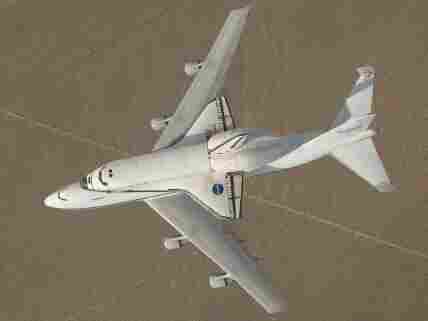
Newton's First Law, or Law of Inertia, introduces or establishes many concepts at once, which we suppose form part of Newton's Laws context. Among them, we can point out space, time, movement, and force, keeping in mind the spatial geometry, that is, motion and direction of forces.
Newton includes concepts of Euclidian space and absolute time in the initial or axiomatic fixation of concepts in his dynamics model; which fully coincide with the Global Physics. It is not the only coincidence since new theory upholds the argument of Newton's Laws as far as being a mechanics theory, and it does not acknowledge any magical effects on physical reality from other dimensions or other worlds.
However, it seems that the context of Newton's Laws dynamics model is empty space, where not even gravitational forces, fictitious forces, or forces that appear in non-inertial systems exist. In spite of the level of such radical abstraction, in many ways Newton's First Law almost accurately establishes the inertial characteristic of movement of the bodies through the reticular structure of matter or Global Aether. As previously mentioned, existence of the Global Aether (gravitational - kinetic - mass) is consistent with the Principle of Mach.
Main problem with Newton's First Law, or Law of Inertia, from the point of view of Global Physics, becomes evident through motion or variation of spatial position of Global Aether, and its effect on movement of electromagnetic energy and energy of the bodies.
The response from Quantum Mechanics to this problem is to assign probabilities to spatial position of the particles, given it is incapable of calculating spatial variation of the Global Aether, because it does not exist in its model.
Obviously, Newton's First Law, or Law of Inertia, as well as rest of Newton's Laws of dynamics suffer from their limited applicability to other types of movement. We can try to adapt concepts to the new reticular context, but we do not think it is always adequate. Sometimes it is better to create new concepts and terms, to avoid same word having various meanings.
Another disadvantage of Newton's First Law, or Law of Inertia, is concept or definition of force, since forces and gravity or fictitious forces do not always behave like what we would call normal forces. We will see this problem later when we discuss Newton's Second Law.
Einstein's Theory of Relativity attempts to resolve two previous problems by making speed of light artificially constant. Therefore, due to movement of Global Aether and tension of longitudinal curvature of Global Aether –which make up the radial symmetry of gravity–, variations on mass and light are resolved mathematically by playing down time and space.
The fact is that Theory of Relativity creates more problems than it solves. Besides the countless singularities and the lack of basic physics concepts, it denies the real existence and effects of the Global Aether, and the new LUM Aether (Luminiferous, universal, and mobile), thereby seriously hindering the advance of science during an entire century.