1.b) Theory of Quantum Mechanics or Quantum Physics
Before appreciating the proposals of Global Mechanics, it is advisable to understand the theory of Quantum Mechanics, its development, and its limitations or weaknesses.
With its non-academic perspective, the presentation of this book addresses to both experts in the field of Elementary Particle Physics and the public in general.
This book is not a super-specialized essay, but it has an advantage; its perspective will match some of the questions an average reader could ask about the content and meaning of the theory of Quantum Mechanics. **
After an extensive exploration of various Wikipedia entries, the most relevant ideas about the development and evolution of Quantum Physics are:
Historical origin
The theory of Quantum Mechanics emerged in the 1920s with the first theories on the atom’s structure and its elementary particles; more precisely, it begun with the explanation of the photoelectric effect by Einstein, taking a step towards the physical approach of the concept of the Planck constant.
Initial scientific context
I believe there to be two fundamental aspects that affected the initial context of the theory of Quantum Mechanics from a scientific viewpoint. Firstly, the rejection of the aether –meaning aether proposed by René Descartes– as a medium for the propagation of light. Secondly, the Theory of Relativity emerged.
The strictness of the non-existence of any aether formulated by the theory of Quantum Mechanics would prevent Particle Physics from achieving a logical understanding of the forces of gravity and will condemn it to attain only a mathematical justification of the physical reality.
At the same time, as both aspects need each other, the recognition of the scientific concept of relativity of time demanded a change in the philosophy of science; eventually turning it into a philosophy of the technical and of utility instead of the philosophy of logical and objective knowledge.
Evolution
The best proposal of the theory of Quantum Mechanics was to establish a limit of physical knowledge: Heisenberg’ Principle of Indetermination, from which it would be possible to create logical and mathematical structures of reality.
As scientists went on observing nature or physical reality, they named them particles and created laws to explain its behavior. Consequently, in Quantum Physics there is a multitude of names lacking in any logical structure (when compared to the names in organic chemistry) and numerous laws and principles with their respective names. It seems there are more names in Physics than in all other sciences put together.
That is to say; things are happening because the principles say so, principles or laws of a descriptive nature and lacking in real logic.
Of course, the principles and laws are good enough until a violation appears; then, they create new laws and principles to explain the violations, with new theories and their corresponding names for the violations, the new principles, and the abovementioned theories.
Quantum Technological development
Contrary to the few practical applications of Relativity, the theory of Quantum Mechanics is responsible for the tremendous technological development in the 20th century in electronics and communication systems, together with all its implications in science and economy in general.
Feynman Diagram Quantum Drawing 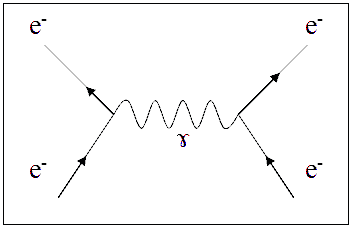
Current scientific context
The mathematical explanation of reality, skipping the most basic logic, ends up being a liability. Also, it generates artificial limits in the development of science and establishes the habit of accepting as science something very irrelevant to science, which reminds us of witchcraft and old wizards.
In Quantum Mechanics, plenty of “scientific” theories coexist. Since its beginning, with the designated Copenhagen Interpretation, numerous theories arose as new characteristics of the structure of matter appeared.
Among the theories above, we can quote the Quantum Field Theory (QFT) and, as part of it, Quantum Electrodynamics (QED) and subsequently, Quantum Chromodynamics (QCD).
To justify the goodness of the Standard Model, Wikipedia says that until today there is proof of the existence of all its particles except for that of the Higgs boson. What remains slightly unclear is that the Standard Model has developed to explain the observations carried out with poor advances in the model concerning the observations, as in the case of the Higgs boson.
Due to the incompatibility between Quantum Mechanics and Einstein’s Theory of Relativity, various unification theories have arisen.
String Theory is the most famous of these, with its even more famous ten additional spatial dimensions. The Superstring Theory has more or less the same dimensions, depending on the particular variant; including the theory that tries to join them all –the M Theory.
Quantum Gravity and Loop Quantum Gravity (LQG) compete with the above String Theory but have fewer supporters.
Less known theories, but more open-minded, are current Transactional Interpretation and Many-Worlds or Multiple Worlds Interpretation.
The Transactional Interpretation argues that in a photon, there is a wave advanced in time and another wave that travels backward in time. As a consequence or effect, the cause-effect logic disappears and something new called quantum logic appears, although we would call it by a different name.
The Many-Worlds Interpretation's opinion regarding the collapse of the probabilistic wave function is that, in manifesting a particular or concrete reality, the objects of the probabilities not in fact carried out will be the concrete realities in other worlds or parallel universes.
I have a slight suspicion that it will take time to prove empirically any of the last few theories. Although, when one thinks about other supposedly proven theories, anything could happen.
As can be observed, this review on the historical development of Quantum Mechanics is brief and adapted to the purpose of this book. On the one hand, it aims to explain and recognize both its achievements and their impressive mathematical complexity, and its huge gaps or weaknesses. On the other hand, to propose logical solutions for the physical interpretation of reality, so that the mathematical tools used to obtain the coherence they deserve.
Particle Physics is a very young branch of science, and it is under fast development, so it probably lacks a solid and structured base for its contributions to scientific knowledge.
Following the quantum logic of to be or not to be, we hope that we have now increased the probability of understanding the positive intention of the presentation of the following negative characteristics of the theory of Quantum Mechanics:
Discrete nature of reality
This property of physical reality connects to the Greek concept of the atom. Another issue is that scientists assign the same discrete nature to abstract concepts such as space, time, force or speed.
The acceptance of magic
There are forces from virtual fields with mathematical properties and without material or tangible cause, however small it may be. That is to say, among many other things, the forces at a distance that upset Newton so much persist.
Influence of mathematics
Quantum Physics, rather than a physical theory, is a mathematical theory, which attempts to describe reality without trying too much to understand it.
If in the mathematical model of elementary particles, the necessary properties of an object with mass do not fit in, the particle does not have mass. It is surprising scientists do not say the particle has any connection with the physical world. Nonetheless, it still exists, and it is a particle!
If something emerges from nothing, they call it a virtual particle. That way, everybody is happy –this is the case of the W and Z bosons, identified in 1983 in the particle accelerator at CERN, Geneva, after the prediction by the Standard Model as intermediary bosons to explain other subsequent particles.
Quantum Logic
As there is a distinct lack of logic, the scientific community itself has established the new expression of quantum logic.
An example of this new quantum logic is what Wikipedia says when explaining the virtual W and Z Bosons: "...that in the middle there was an asymmetry of mass-energy so brief that it’s as though reality itself didn’t register it".
Other examples could be the appearance of theories with a lot of dimensions, worlds, and time-travels.
Some of them even say the human brain is not good enough to understand reality. Well, perhaps theirs is not! We imagine the reason is this quantum logic, or to describe certain somewhat unique brain types. For example, those brains which only use one percent of their capacity!
A theory that is neither proven nor demonstrated
Despite all its technological accomplishments, the theory of Quantum Mechanics is not proven or demonstrated the theory of physics beyond its descriptive character of the observed reality. It is not even a Physics theory; it is a branch of Physics studying the structure of matter with a particular perspective, in which different alternative theories coexist.
Also, apart from some recent attempts, more philosophical than scientific, all these theories are incompatible with Einstein’s Theory of Relativity.
To sum up, Quantum Mechanics has substantial internal contradictions, and it seems that, given the new proposals, there is a consensus that it is in a phase in which necessary changes or essential restructuring could occur in the short term.
Nevertheless, we believe quantum phenomena are fashionable now and expanding in areas like the philosophy of existence and time; occasionally touching upon the concept of quantum God.
Sometimes things are difficult to understand, on other occasions they are more difficult to explain; perhaps the true story of the little Molwick, doing a quantum logic course for gifted children, will be illuminating:
* * *
The teacher of the course explains a quantum experiment:
–When someone pushes a button,
an image appears on the monitor;
however, detailed measures indicate that the image on the monitor
appears even before pushing the bottom.–
All the kids are thinking about it
and very impressed;
then the little Molwick asks:
–What happens if when the image appears
someone decides not to hit the button?–
...
The children and the teacher start to think about it again.