3.a.2. Stable and unstable subatomic particles
We have seen how fundamental particles –the smallest subatomic particles of physical mass– create through an intense process of torsion of the reticular structure of matter or Global Aether, which generates a different state of physical matter, where the main character is the accumulation of elastic energy in curls or spirals of resonant mass.
We have called this phenomenon of a change in the state of matter the interaction of mass or black interaction, due to eliminating the torque stress –transversal tension– from the electromagnetic wave and transforming it into the tension of longitudinal curvature –gravity– and reversible deformation energy of Global Aether –mass.

We have also seen in the previous section properties of subatomic particles in general, such as their clockwise and counter-clockwise spatial nature, and we have mentioned their stable or unstable nature.
Stable subatomic particles will have some mechanism to prevent the spirals or loops of the reticular structure of Global Aether from easily becoming undone, despite the tendency to return to its initial state due to the elastic energy.
The figure shows a rolled-up blanket with a knot to intuitively represent a possible mechanism of stability, although it cannot be like that.
There will be more detail regarding stable elementary particles and their maximum size in the section of this book on Particles of the atom of the new atomic model put forth by Global Mechanics.
Characteristics of subatomic particles:
Sliding of subatomic particles
As has been previously explained, electromagnetic waves, or photons, and other particles without mass represent small twists or transverse (or torsion) deformations of Global Aether. When these twists join in space with opposite direction, they create half-folds, complete loops or spirals of physical mass.
If the loops receive more energy or torque force from one side, they will slide until they reach an equilibrium in the transversal tensions of torsion received through the loop ends. In this case, intuitive description of the movement of the particles with mass would be the displacement of a slipknot.
Recently (2016) I have found that the theory of knots Lord Kelvin ** can point to as a clear precedent of Global Mechanics. This theory proposed that the various atoms correspond to different knots in the classical aether. Logically, the advent of Relativity discarded it, because of the general denial of the existence of any aether with mechanical properties.
Relativity assigns these mechanical properties to space-time itself, thus avoiding mentioning the word aether. Suffice to say that the detected gravitational waves drag light, according to LIGO experiment.
Nature of very unstable subatomic particles, or gravitational skip
If the subatomic particle is at a point in a potential valley, like the electrons in their orbits, by changing the differences in potential the point will cease to be a point of equilibrium, and the particle will become undone due to its elastic tension. The freed electromagnetic energy will travel at the speed of light until it finds a new equilibrium in a minimum potential but in another valley, where it will appear again as a subatomic particle with mass.
We can call this phenomenon a gravitational skip –little jump or Tunnel Effect – because it will typically take place at very short distances. It defines a new type of subatomic particles. We will also find it again in the page corresponding to the new atomic model of the Physics of Elementary particles proposed by Global Mechanics within Global Physics.
The wavons
The necessary distinction between the expressions dual nature of matter and the new type of subatomic particles suggest the creation of a second type of duality – mixed or intermediate as far as the duration time with one nature or another is concerned.
A generic term for these strong waves could be wavons. That is, they would be subatomic particles that acquire mass between the skips or tunneling effects that we referred to previously. They exist as material loops, and they leap at the speed of light like photons until they reach a new equilibrium in the gravito-magnetic tension. The term refers to the fact that electromagnetic waves would be abundant, and powerful, derived from the existence of the loops or curls that characterize physical mass.
We name wavine the mass of wavons to differentiate it from the mass in the strictest sense (squeezed matter). Occasionally, the term mass is used for both types of states of physical matter in a broad sense, because both are made up of half-fold, curls or loops of Global Aether.
It will be necessary to use this distinction when analyzing the physics of movement in the book of Global Dynamics. Let us remark that both stable and unstable elementary particles with mass slide through Global Aether like the abovementioned slipknots.
Unstable subatomic particle Heyelogic echography 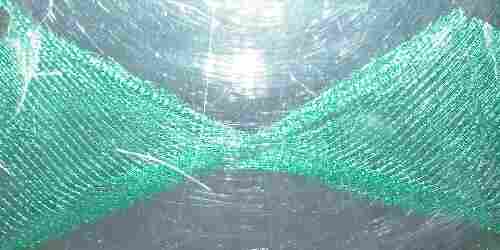
The heyelogic figure shows a 180-degree rotation on a bi-dimensional net. We can intuitively observe that there is nothing to stop the rotation from reversing if the tension that produced it were to disappear and if tended to return to its flat state.
Electrons
As we said, electrons slide like slipknots within their orbits. The orbital movement of electrons has special conditions, which we will examine in the section on the Atomic structure of this book.
Curl in the Global Aether slip knot 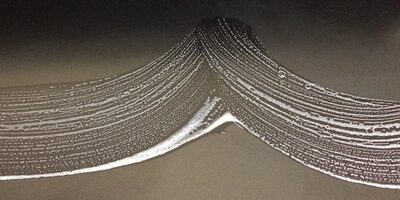
Likewise, due to being wavons, electrons also travel by leaps or skips between orbits.
This characteristic of electrons explains the Tunnel Effect experiment –which should be the jump of the wavons experiment.
Furthermore, the mixed movement of unstable subatomic particles would easily explain the Young experiment or double-slit experiment done with electrons, making it impossible with nucleons.
Finally, an electron can slide like other particles with mass as free electrons.
Antiparticles and spatial lengthening of Global Aether
A fascinating topic in Particle Physics is the association that emerges between subatomic particles and black holes, which, upon their formation, are large accumulators of mass and elastic energy.
Another comparison between subatomic particles and Astrophysics refers to the processes of contraction and expansion of Global Aether, which take place at both an atomic level as well as at the level of stars and galaxies –as described in particular detail in the book Astrophysics and Global Cosmology.
When two fundamental particles of opposite spatial nature, clockwise and counter-clockwise respectively, are also leaping or unstable, and contact with each other, they annihilate each other and thereby producing other particles and photons based on their distinct energy.
With the collision between the antiparticles that make up antimatter and normal matter, the loops will cancel out immediately without creating transverse torsion, since the transverse torsion will also compensate. However, the elasticity in the Global Aether, which gave rise to the initial curvature and the formation of particles and antiparticles, will make Global Aether to recover its volume thanks to its characteristic of reversible deformation energy.
For future reference, we name spatial lengthening of Global Aether to this physical phenomenon.