2.b) Global Aether as a state of physical matter
According to Global Mechanics, the definition of gravity is that it is the first state of physical matter and the one with the highest symmetry. The total symmetry of a structure of non-radial reticular matter is purely theoretical because it does not seem to be present in physical reality.
The above definition of gravity as a state of physical matter implies a change of paradigm in Modern Physics, so it is convenient to keep an open mind while trying to understand the essence of the proposal and not to search for little mistakes. For example, whether the shape of the reticule of the structure of matter has one particular form or another is not important, as long as it fits the required properties of the model, and as long as the model explains the physical reality in a way that makes more sense than that of other models. In this case making a minimum amount of sense would be enough, since the forces at a distance are difficult to justify from a scientific point of view, not to mention physical dimensions in other worlds or contractions of space or time themselves.
The Standard Model of Quantum Theory depends on points in space with emerging, virtual, or mathematical properties. In the current philosophy of science, the word "emergent" justifies unexplained Huygens phenomenon, avoiding magical or religious arguments, as in the case of the generally accepted Theory of Evolution, by Charles Darwin.
Classical Physics did not connect aether with the radial symmetry of the reticular structure of gravity or first state of physical matter –if we do not count the hypothetical total symmetry of matter–. The disciple of Descartes, Christian Huygens, described aether as subtle balls of air in contact to be able to transmit light. Augustin Fresnel concluded that light waves were transverse waves when he was studying the polarization of Iceland spar, or calcite.
As for partially relating Global Aether with classical aether, we have to point out that the idea of an aether differing from the classical concept it is not exclusively of Global Physics. The already demonstrated Quantum Mechanics theory also uses the term quantum foam or quantum vacuum to recognize that the classical vacuum is not empty, and avoids mentioning the word aether with different characteristics. Also, well-known String Theory proposes something like an aether of little vibrating strings and different states of physical matter, including numerous additional dimensions.
"The time of the big collision is coming - LHC
We think that the universe’s vacuum is not nothingness, it is a substance that can vibrate, and the interaction of vacuum - which is not really vacuum - with the rest of the particles (a kind of friction), is what would generate its different masses."
El País 09-03-2008 (Nature)
Once we have related the most intuitive characteristics of the state of the physical matter with radial or gravitational symmetry, we can go on to add other characteristics, less intuitive and with less probability of being correct. In any case, if during the line of argument, we come to any contradictions we can always renormalize the proposed characteristics –as long as the efficiency of the model, concerning its capability of explaining the observed phenomena, increases and providing the model as a whole is still coherent.
Throughout this book, we will apply additional properties and mechanisms of gravity –or the first state of physical matter– to understand complex phenomena such as electromagnetism, the weak and strong nuclear forces or black holes. Regardless, we will begin to relate the specific characteristics and properties that will be useful to explain the force of gravity from Global Mechanics.
Once we have determined these properties, we will see the classical gravitational interaction and the behavior of the forces of gravity at short distances, close to the elementary particles with mass.
Given the unification of gravitational and electromagnetic interactions –because the first state of physical matter is their common medium support– the electromagnetic interaction is included in the chapter on gravity in the book.
The attempt is to characterize functionally the reticular structure of matter or Global Aether as a support of the forces of gravity; backing Global Physics when it says that Global Aether will be present, in one way or another, in all known physical processes.
Taking into account the previously quoted general properties of matter and the specific properties of the gravitational field, the characteristics of Global Aether or state of physical matter supporting gravity are the following:
Material composition
The composition of matter in the case of gravity is merely the Global Aether; that is to say, Global Aether does not have an intermediate state of physical matter.
It is odd that some people still prefer to accept magical forces emerging from nothing, rather than accepting non-detected matter with our current technology; despite all the indirect signs that one could imagine.
The virtual or mathematical nature present in the definition of the field of gravity is understandable, due to the initial impossibility of characterizing it in any other way –as Newton himself showed. Perhaps it is now time to change the nature of gravity slightly.
The continuous nature of material support of gravity
The parts or elements of said material structure supporting gravity must be connected, as an isolated part could not exert a radial or ordered force nor could it maintain its spatial structure. We have already established that continuity is a general property of physical matter.
Another question is whether potential energy has a continuous quantitative nature or whether it is discrete as in the case of electromagnetic energy. We would say that it would also be discrete, as well as related to the Planck constant and the internal elements of the filaments in the Global Aether.
Nevertheless, the continuous nature of the material support of the gravitational field requires the development of the concept and characteristics of the force of gravity, which we will present in the next chapter.
Invisible
Not only we cannot see the reticular structure of matter or Global Aether, or the phase of matter that configures gravity, but also until now, there is no recognition of it. Another way to look at it is that from the inside of a box, one cannot see its external perspective, not without a little bit of imagination and without using, at the very least, 20 percent of the capacity of the average human brain.
-
The tension of the longitudinal curvature, rigidity, and additive
We already know that the forces of gravity are additive, so the structure or states of physical matter generating these forces must also have the same property, at least about the component mechanisms of gravitational fields.
The potential gravitational energy is due to the tension of the longitudinal curvature caused by mass as it bends the filaments of the reticular structure of matter with initial, total symmetry. This tension generates forces perpendicular to the tangent at every point of the filaments, which is coherent with a curvature decreasing asymptotically with the square of the distance.
The state of physical matter, which configures gravity, has to be rigid enough to support forces that can move the universe’s planets and stars far away from their origin. In other words, the elastic tension of Global Aether exists on a much more rigid structure than that of any other known material.
Regardless of this, at great distances, the phenomena of contraction and expansion of the reticular structure of matter or Global Aether are also significant.
-
The radial symmetry of the longitudinal tension
The initial total symmetry of Global Aether breaks down when mass generates a radial symmetry with an asymptotically decreasing tension of the longitudinal curvature of the filaments.
The hypothesis on the exact shape of a reticule of the structure of matter with total symmetry was the cube or another geometrical figure with a high symmetry, to permit the observable gravitational effects in Euclidian geometry when introducing radial symmetry. In any case, the radial symmetry of the forces of gravity is more due to the elasticity of Global Aether than to the particular shape of the tiny reticule.
Global Aether State of physical matter 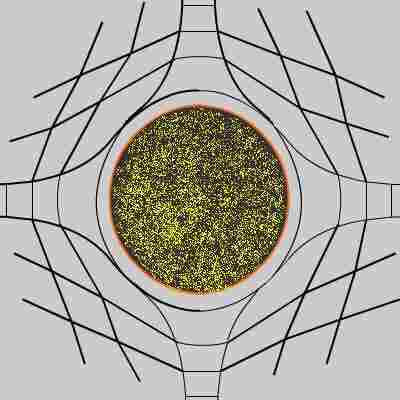
This radial symmetry is slightly different from the typical radial symmetry of the drawings of the Sun with its little yellow rays.
The heyelogic microscope gives us a perspective of Global Aether greatly amplified so that we can observe how Global Aether filaments come closer together the further they are from the mass, despite the radial symmetry.
If we put a ball inside one reticule of Global Aether, and the ball is much bigger than the reticule, the filaments of the said reticule and the adjacent reticules will not only stretch due to their property of longitudinal elasticity; they will also acquire a longitudinal curvature.
In other words, the elastic deformation of the filaments will occur; and they will tend to go back to their original state.
Global AetherAI Bing Image 
For now, this approximation of the state of physical matter, which configures gravity, is enough; the origin of the ball is in the chapter on the composition of mass.
One could consider gravity as an almost rigid solid that becomes very flexible at very short distances, according to the longitudinal curvature produced. In short, Global Aether is a very solid and rigid structure, and at the same time very elastic and flexible for materials currently known. One can consider how hard a metallic object is and how easy it can be to pull an atom from it, or the remarkable properties of diamonds –being both hard and fragile.
To sum up, the less intuitive idea is the movement of mass through the physical structure of gravity. The switch to the elastic model of Global Mechanics precisely implied a renormalization of the hypotheses regarding the movement of mass vis-à-vis the older semi-rigid model.
On another hand, it seems as though the propagation of gravity will have a different nature than that of the transversal waves of the reticular structure, although it does do so at the same speed. Another thing would be if a mass were to move fast enough to generate changes in the filaments’ curvature, eliminate and then regenerate itself –then, one could talk about gravitational waves at relatively short distances to avoid going into the asymptotic zone of the curvature of longitudinal tension.
In any case, the longitudinal waves of Global Aether would have a different physical sense to the propagation of a wave on the surface of water or the propagation of electromagnetic waves. They would be more like the vibration or resonance of an atom, and they connect to this phenomenon. We will explain it in the book on Global Dynamics with the concept of movement.
Now, we are ready to present on the next page the model of gravitational interaction within the first state of physical matter.