3. What is mass?
3.a) Interaction of physical mass
We have seen how electromagnetism reflects the torque forces of the filaments of the reticular structure of matter or Global Aether, within a simplified view of reality, to express the concepts.
Global Physics has approached gravitational and electromagnetic interactions when saying gravity field is the LUM Aether (Luminiferous, universal, and mobile). Now it should be easy to unify both interactions entirely through the mass interaction since we already have a quantitative equivalence using the equation E = mc² from Theory of Relativity, that does indeed quantitatively coincide, albeit partially, with physical reality.
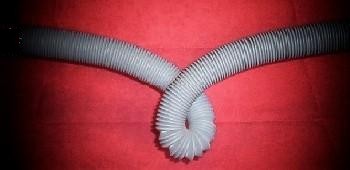
The unification of the gravitational interaction with the interaction of physical mass consists of the same energy process like that found in electromagnetic waves, but highly intensified to be able to create physical mass.
The interaction of physical mass will require electromagnetic waves in a region of the Global Aether to produce a half-fold or a complete loop of its reticular structure and to relax the torque stress or transversal torsion. This process involves an additional form of physical collapse of the wave, which is when said torque stress transforms into the tension of longitudinal curvature and tension of reversible deformation or compression of Global Aether, to form the fundamental particles of mass.
Taken to the extreme, this process of the theory of mass explains in the online book of Astrophysics and Global Cosmology what black holes are and why they form. It implies that fundamental particles of mass share characteristics with black holes and vice versa.
Therefore, we can establish the definition of physical mass as compressed and coiled matter, because it relaxes electromagnetic waves while creating.
To better understand what physical mass is, its definition, and its most essential characteristics, we can take a look with the heyelogic microscope at the main steps of the creation process of an elementary particle:
Torsion Spirals
In the heyelogic figures, we can observe how loops form by increasing the torsion on the filaments of the Global Aether. That is, the loops in the interaction of the mass of fundamental particles form because of the torque stress of Global Aether.
We said earlier that the complete loop produced by torque stress implies a change like the stress from transversal to longitudinal tension. In other words, the electromagnetic elastic energy becomes gravitational potential energy and reversible deformation energy –a purely mechanical effect.
It will be the first step of the theory of physical mass in the creation of the new state of physical matter different from that of gravity.
One has to imagine the Global Aether in a three-dimensional space of Euclidian geometry, to try to visualize what shape these loops or curls will have. We think they could generate something similar to a small sphere, or spirals. In the case of an electron, it could be like a half-fold o bend.
Global aether Creation of loops, spirals or curls 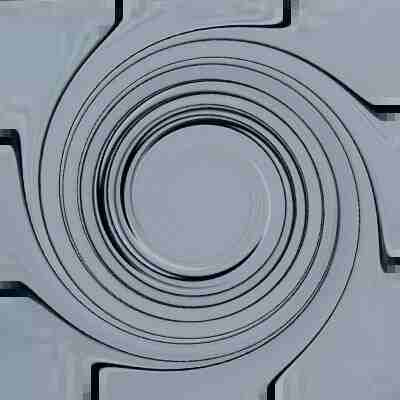
The half-fold or complete loop of the fundamental particles with mass will create where the elastic torque stress –transversal tension– or electromagnetic energy surpasses a physical limit related to c2 and the mass of the electrons.
Spatial contraction
The creation of the loops in the fundamental particles in the theory of mass will shrink the three-dimensional net or grid of matter or Global Aether, and therefore, it will involve a reticular shrinking phenomenon. As a result, based on the definition of mass we can gather that a property of Global Aether is volume reduction or spatial contraction, at a very high percentage, and compaction of the filaments.
The spatial contraction of objects is a natural phenomenon and common in many areas of physics and should not be confused with the contraction of space. Something that gets smaller reduces or shrinks; the concept of contraction of space itself is unnatural, and all it accomplishes is to complicate reasoning and move us away from physical reality. Some arguments of Modern Physics remind us of the creative accounting of Modern Economy.
Curling a loop and accumulating elastic energy
In the new theory and definition of mass, if there is an initial spiral, loop, or curl in the Global Aether, and the torque stress maintains with more electromagnetic waves upon this initial curl. Then, new loops or curls will create, but there will be a tendency to undo themselves if nothing prevents it. However, as we will see later, there could be some crack generating an energy barrier of stability –electrons–, or a jam between filaments of the cells of the Global Aether –protons and neutrons.
A visual, very intuitive and renormalizable approximation of the definition of physical mass would be a ball made up of rubber bands. In the figure, longitudinal rubber bands and not the local torsion of a three-dimensional structure of filaments constitute the ball.
In short, according to the definition of mass, the new elementary particle will have strongly compressed filaments by the disappearance of the three-dimensional spaces of the reticules with the creation of the curls, which will end up producing a material structure of coiled and jammed filaments with a much greater density than Global Aether. It will have lots of elastic energy due to the accumulated torsion. These are the fundamental particles of the definition of mass, configuring a new phase or state of aggregation of matter called physical mass.
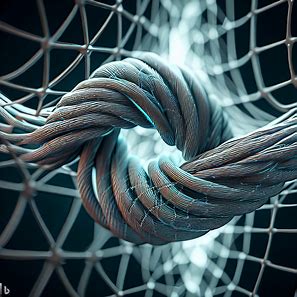
This analysis is consistent with the formula of equivalence between mass and energy, and that electromagnetic waves violate the law of conservation of mass. Nonetheless, we would not suggest that mass and energy are the same or identical terms, only that they are equivalent from a specific perspective.
Indeed, both physical mass and electromagnetic energy are elastic characteristics or properties of Global Aether in different stages of physical matter.
of mass
In several sections of the book on the Law of Global Gravity, there is a more detailed explanation regarding the quantitative relation between mass and energy.
Dealing with this topic of the equivalence between energy and mass, we once again come across a terminological issue since, although the concepts of mass and matter are ever-changing, Modern Physics continues to use the terms of states of physical matter to identify what are sub-states or types of aggregation of mass. Moreover, normal matter contains Global Aether, mass, and it has properties such as nuclear energy, electromagnetic energy, thermal energy, and kinetic energy.
In the following sections, we will delve into the definition of physical mass and some of the physical limits or conditions of what mass is, which will allow us to analyze the characteristics and types of motivating elementary particles.