3.e) Global Aether (kinetic) and acceleration
Definition of acceleration is very simple since it is the change in velocity per unit of time. In Global Dynamics, with Euclidean space and absolute time, the concept is easy, although new types of movement appear as we have seen in the corresponding section.
The Global Aether supports gravitational field, kinetic energy, and the mass; hence, we can use the names interchangeably. The different names help the brain keeping in mind the many properties of Global Aether.
There is a problem with the concept of acceleration due to Theory of Relativity and its Equivalence Principle in regards to time, and the very same relativity of space.
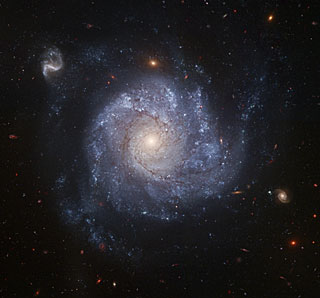
(NASA) (Public domain image)
The Equivalence Principle of General Relativity affirms it is not possible to distinguish between effects of gravitational acceleration and physical acceleration due to other causes. The book Theory of Relativity, Elements, and Criticism has a section on this principle, where it comments some errors of the lift thought example –not experiment.
In particular, the book says “However, this example of the lift would work neither for the light nor a person and a gyroscope in the lift, because none of them would suffer the same force of gravity.”
Despite the previous example, it is true these concepts have many elements in common, and it is essential to understand the mechanisms and causes of acceleration to establish when and why they behave the same way, or they differ. Therefore, respecting empirically observed facts and without needing principles artificially imposed.
Let us look at the following example:
Enchanted forest
Let us imagine a space with trees, where we are going to stroll. It would be an enjoyable stroll if there were not too many trees impeding us very often the passage. In other words, in this forest will be a specific density of trees, innate and independent of the observer. Without a doubt, other forests may be more or less populated.
Now we are going to the same forest to jog; we will notice we have to be more careful than when we were strolling not to run into the trees. The faster we go, the more crowded the forest seems; that is, acceleration changes the subjective density of trees in the forest.
Now let us imagine, but only for a moment, we are giants, and we are going for a picnic in the enchanted forest. Surely, the forest will once again appear more crowded than the first case.
Likewise, but the other way round, we could be in three different forests as far as their tree density, but density perceived by each observer were the same.
The scientific work, in this case, is not to maintain this apparent confusion of the forests with relative definitions because of the natural subjectivity of our senses.
Nor it consists in defining a different system of measurements’ units for each situation, making impossible to grasp an intuitive idea of reality. Moreover, much less force us to calculate equations as if we were in any lost forest of the universe to take a small stroll through woods by our house.
This example of the enchanted forest helps us understand partial equivalence between gravity and velocity, or between variations in gravitational field and acceleration –speed variation.
As we will see later when discussing movement with gravity, the frequency of mass resonance changes with gravity and with variations in velocity due to the mechanism of movement through the gravitational or Global Aether.
A typical relationship between acceleration in the Global Aether and gravity acceleration is elementary physics since the main effect of gravity is a centripetal acceleration by definition; that is, a force per unit of mass an object endures aimed toward the center of the gravity field of another object.
Moreover, physical units of the definition of gravity coincide with acceleration in general. Mathematically, gravity is a particular case of abstract acceleration. Nevertheless, besides constant G and its units, it is necessary to add another term into the formulae of gravity –with its units– to collect the additional gravity force due to velocity relative to Global Aether.
Gravity acceleration is due to the elasticity of the reticular structure of matter or Global Aether (gravitational, kinetic) and its radial symmetry.
Furthermore, as we have commented in other sections, two components of atractis causa generate a global force of gravity. There is no distortion of space or time, just of concepts in some physics theories.
Interesting cases of acceleration due to the force of global gravity are:
At times, according to the definition of gravity acceleration, it can be null due to the effect of two gravitational fields balancing each other out; but the non-existence of longitudinal curvature of the filaments of Global Aether does not mean its longitudinal tension is the same.
Regarding orbit of the planets, Newton's Law of Universal Gravitation provides us with necessary relationships between inertia or centrifugal force and gravity or centripetal force to obtain a stable orbit of planets.
However, Paul Gerber, General Relativity with space distortion by energy, and Global Dynamics, with its Merlin effect explain the small anomalous precession of planet orbits –in chronological order, with the same formula, and different physical theories.
With velocity, mass increases with or without the presence of gravity field, but only within gravity field, there are also intrinsic variations in the force of gravity per unit of mass, because greater energy interchange occurs due to velocity –or kinetic energy–. Merlin effect refers to this phenomenon.
The variations in force of gravity to which Merlin effect refers differ from both those derived from variation in distance and variation in mass in Newton's formula for gravity.
Another relevant aspect of the development of the theory of gravitation is the force that produces curvature of light in the presence of mass. This fact, oddly enough, depends on two times Newton's gravitational acceleration, as General Relativity recognizes and justifies with space distortion due to energy.
For Global Physics, cause for the double curvature of light is again the Merlin effect, or the second component of atractis causa of gravity force explained in the book Law of Global Gravity.
In both cases, General Relativity states the cause of space distortion is total energy; in other words, it seems gravity is just space distortion. Consequently, reasoning vanishes and it is not clear gravity force is double for electromagnetic and kinetic energy, but not for mass at rest equivalent energy. This characteristic is essential to understand causes and mechanisms of movement in the Global Aether, with or without gravity.
Global Physics bases on Global Conservation Principle that, as his name indicates, represents a more general equivalence than Theory of Relativity, by including gravity together with mass and energy. Nonetheless, it is different, and it supports the extension of classical Principle of Energy Conservation.
On the contrary, as far as differences between gravity and other acceleration through the gravitational, kinetic or Global Aether, the equivalence is more restricted since it does not end up representing an identity between concepts of acceleration and gravity and much less assigning temporal effects to any of them.
Proposed global equivalence seats on the unification of fundamental forces by Global Mechanics and in energy effects studied by Law of Global Gravity and Global Dynamics regarding velocity, acceleration, and gravity.
In the example of the enchanted forest, if there are more trees or we move is equivalent to the forest moving toward us. To the effects analyzed, the three cases are indistinguishable. However, the number of trees is different if we know how to do the calculus.
Lastly, besides not assigning temporal effects to gravity and velocity, Global Dynamics, by explaining the orbit of Mercury and curvature of light with the Merlin effect, makes unnecessary the principle of equality between inertial mass and gravitational mass –from both Classical Mechanics and Einstein's Theory of Relativity.
The mass definition in Global Mechanics derives from its physical reality and not for its inertial or gravitational behavior. Mass has one concept, and its behavior depends on interacting energies with their corresponding forces.