
3. DYNAMICS - PHYSICS OF SPACE AND TIME
Development of Global Mechanics has explained the gravity-energy-mass equivalence when unifying force of gravity with electromagnetic energy, and the elucidation of how mass creates within the reticular structure of matter or Global Aether.
Likewise, Global Mechanics gives clues to development of Global Dynamics that studies causes of movement.
After Newton's Laws, two problems emerged regarding dynamics in space and time, effect of gravitational lens of light and anomalous precession of the perihelion of Mercury. Einstein's relativistic mechanics resolved both glitches, although incorrectly in our opinion. Besides, General Relativity is also incompatible with both Quantum Mechanics and Global Mechanics. Nevertheless, Paul Gerber explained the precession of the perihelion of Mercury in 1898 with same formula.
Furthermore, Relativistic Mechanics alters basic concepts of dynamics by playing down the very same space and time, especially when reversing concept of velocity.
Quantum Mechanics, in turn, discovers new conflicting ideas within Newton's Laws of Dynamics, the world of the atom and elementary particles.
Global Dynamics not only resolves the problem of curvature of light and anomalous precession or small deviation in the orbits of the planets but also it distinguishes between different types of movement apropos their causes or nature of forces that bring them about.
Study of causes of motion in Global Physics has implied the advent of a new perspective in classification of different types of forces and energy.
Therefore, Newton's Laws of Dynamics need a small quantitative adaptation and a large conceptual change, especially in its scope of application.
Before explaining the mechanisms and forces of movement of light, and the bodies in free fall –their motion upon the LUM Aether (Luminiferous, universal, and mobile), Global Aether or through both–, we will analyze the basic elements of dynamics, such as space, time, movement or velocity, acceleration, and force.
3.a) Concept of space
Both time and space are conventional concepts or mental elaborations to understand this world and try to represent the dynamics of the reality. Concept of space is necessary for a definition of movement.
Currently, meter definition within Relativistic Physics depends on the speed of light, which, in turn, displacement depends on relative time. It cannot be simpler!
In spite of spatial notion being simple, the human brain has problems managing three spatial dimensions in many branches of knowledge. Therefore, we have to be especially careful with scientific definition of space, not to make it more complex than necessary.
As always, the brunt of science regarding space and time consists of establishing some conventional patterns that can apply in all situations, can allow for comparisons, and are as simple as possible.
The result will allow a powerful understanding of the reality, which will enable greater scientific and technological development of society.
The book Global Mechanics explains known processes of expansion and contraction of space without abandoning the nature of Euclidean space, or three-dimensional space.
Furthermore, Global Dynamics allows us to understand an important characteristic of the concept of relativistic space.
We hope the following example will help understanding different nature of space in Global Dynamics and Theory of Relativity. It is not an exact example but it comes close and, at times, it can help apprehending relativistic texts.
Example of crossing a river
Imagine we have to cross a small river and there is no bridge. We will have to find a place with stones, so we can cross by jumping stone to stone, to the other side without getting wet.
Concept of relativistic space 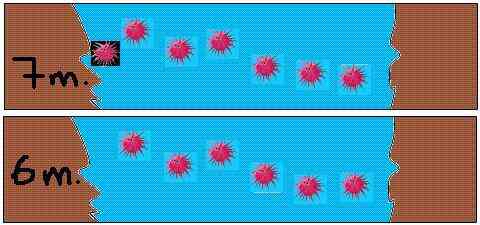
Relativistic dynamics would state that the river is seven meters wide where we can cross if we jump onto seven stones. That is, if a month later someone puts another stone to make it easier to jump across, relativistic mechanics would state that the width of the river is eight meters. Also, if a stone disappears dragged away by the water, or by a stone thief, then it would be six meters.
This chaos is due to Theory of Relativity not allowing stones in the riverbed. In other words, it ignores the Global Aether as medium support for gravity field and mass.
We should not confuse gravitational field –LUM Aether (Luminiferous, universal, and mobile)– with Global Aether.
Likewise, we should no mix the gravitational field drag effect on electromagnetic energy that explains the Michelson-Morley experiment with Merlin effect. The second component of atractis causa in the gravitational interaction –Merlin effect– clarifies the phenomena of the curvature of light in gravitational lens and anomalous precession of the orbit of Mercury and of the planets in general, as we will see when discussing movement of free falling bodies.
In Global Dynamics, there are other divergences between relativistic space and Euclidean space due to mathematical effects of relativity of time and its different causes, but this is not the time to analyze them. In any case, if Global Aether confirms, Einstein’s Theory of Relativity immediately vanishes.
3.b) Nature of time
Basic elements of Global Physics are space, time, and Global Aether, since everything else derives from them.
Time has various meanings as we have commented in section Theory of time in the Metaphysics book, Equation of Love. As far as dynamics and scientific method, relevant concept should be absolute and objective time because it fulfills scientific objectivity, and is much simpler.
Although we perceive reality in many forms and, mathematically, some models offer very precise calculations, it does not seem that the Imperial System of Measurements is as simple as the International System of Units (SI), ignoring relativistic units from the latter.
There are things that, for their significance, should be proven, or be able to be directly proven if they want to belong to science and not just to philosophy. We think that no one or anything has traveled in time, except travel in absolute time, which we are all familiar. Likewise, no one has seen space-bending, and later straightening; or movement through other physical dimensions that only exist in abstract terms (Contradictus in terminus).
Likewise, in the book, Theory of Relativity, Elements, and Criticism, we have dedicated a section to the concept of space-time.
For a truly functional and efficient concept of movement, the unit of time should be independent from energy. Currently, the second is certainly relative, given that it depends on the vibrations of the Cesium atom, the period of which derives from certain energy levels that depend, in turn, on many factors. Second definition takes into account some of them, but others not; so it keeps dependent on them, like velocity and gravity.
We only need to change time definition, or better said definition of second established in 1967 by the International System of Units, so it does not depend anymore on environmental changes.
Besides easing reasoning, the new definition of time would allow us to discuss dynamics in Euclidian space and absolute time by specifying both simultaneities of events and cause-effect sequence.
It is worth remembering that relativistic time denies simultaneity and that certain branches of Quantum Mechanics openly defend the inexistence of the cause-effect sequence, which is certainly indispensable, even in philosophy. No doubt, the opposite is mad science.
The physical experiment of the Invisible Clock, proposed by Global Physics, directly deals with controversial measurements of time and the god Chronos. The idea of this name is to highlight the fact that clocks alter with velocity and gravity. A perfect clock would be an invisible one, in the sense of being independent from any condition; that is, it may not be enough to be invisible, but the idea it conveys is still valid.
Regarding the problem of simultaneity in Special Relativity, we propose the scientific experiment of the Abrujuela’s Train, keeping in mind speed of light and rotational movement of the Earth.
In short, we believe absolute time, for scientific purposes, to be a monotonous, uniform, constant and growing function.