|
Molwickpedia From Google Toolbar |
MOLWICKPEDIA
Free online science books Philosophy of evolution, history and life Biology of the brain and psychology of cognitive functions
THE EDI STUDY
ELEGANT DESIGN OF INTELLIGENCE! |
|
|
|
5. Social model of intelligence5.a) Statistical data of homogenous groupsThe weak adjustment obtained in the previous section was foreseeable; I have already commented in the initial specifications of the model about the nature of intelligence, that the proposed estimator would be centred, but that its variance would be very large due to the random character of the Mendelian inheritance. Also we have indicated the impossibility of correcting this problem of the statistical data by selecting 50% of the sample where the deviations would have to be minimum. Lack of precision in measurements and temporary and functional deviations of the intelligence expression due to its nature are the main causes. The problem with the statistical data regarding the nature of intelligence is greater than expected. Consequently, the analysis by groups seemed the only way to surpass the mentioned limitations of the avaliable statistical data. The aggregation, by itself, would not be satisfactory since the values of all the variables would tend to equal the average as the group's elements increase. To avoid this tendency of the statistical data, different groups are obtained depending on the various orders into which the initial seventy values can be arranged. If we rearrange the initial sample with criteria such as M1F1 or (M+F)/2 it will be possible to achieve homogenous groups in which:
For each variable, a hundred and ten different variables have been generated based on the diverse number of elements and criterion to rearrangement of the groups; I have used ten group sizes and eleven criteria of arrangement, including the initial order (unknown). The following graph contains the number of elements of the sample that will exist for each group size. The model about the nature of intelligence has been examined in its double formulation, on one hand, calculating the correlation with respect to the objective function R, determined in accordance with the General Theory of Conditional Evolution of Life (GTCEL). On the other hand with respect directly to the variables of the statistical data M and F, it allows for a comparative analysis between the two formulations. The variables used to rearranged the groups were M, F, R, M1F1, (M+F)/2, 2F2M, C1, C2, C3 and W. Variable 2F2M will be opposed conceptually to M1F1; C variables correspond to those children who have been studied in a particular analysis and W variables are generated artificially in the model simulation. The final effect is that the statistical data evaluated by the model about the nature of intelligence has been multiplied several times over and random variations have been compensated. Consequently, its power to detect the correction of its specifications has improved significantly. At the same time, the model of evolution of intelligence has become very sensitive and can compare between close configurations of the statistical data. 5.b) Quantitative approachDue to the great amount of data generated with the quantitative approach to the nature of intelligence, and to facilitate its analysis, in addition to the results in tables, it appears in graphs. (See statistical annex). Indeed, an almost instantaneous perception of the exactitude of the particular specification is obtained with the quantitative approach; sixty coefficients of determination (r²) are shown in a way that highlights the global and underlying relations of the involved statistical data. 5.b.1) Stanford Binet and Wechsler IQ test) The results of the quantitative approach are surprising regarding the nature of intelligence, which can be observed both in the graphs of the statistical annex and in the following tables. An aspect that will especially allow us to reach some important conclusions is the model sensitivity of the arrangement criterion. The model on evolution of intelligence adjusts perfectly, showing a determination coefficient r² superior to 0.9 in several cases. Also, it is interesting to verify the fact that the objective function R is almost as powerful as mothers' variables M and fathers F together. The great increase of the correlation for the estimation of homogenous groups of the statistical data cannot be imputed to the reduction of 68 to 5 or 4 degrees of freedom, since the estimation with non-homogenous groups, without previous rearrangement, has the same degrees of freedom and the correlation even lowers with respect to the sample without grouping. If we estimate with respect to mothers' variables M and F, we obtain an r² of 0.99 for variable WB (Wechsler intelligence test) when the rearrangement variable is the same WB variable. This good adjustment is possible because, in their configuration, the children variables C not only incorporate criterion M1F1 but the real information of the power of all the genes and their correct Mendelian inheritance combination, in agreement with the GTCEL. Variables M1F1 and R only incorporate, so far, a partial effect which is the Mendelian inheritance and, therefore, variable WB (Wechsler intelligence test) is a better order criterion. Nevertheless, this does not take place in all cases; it is definitely a consequence of the incorporation of the differences due to the expression and measurement of the IQ in C variables, which does not happen with variables M1F1 and R. The next table shows the G-MCI and the maximum r² of the correlations between the IQ of the parents or the objective function R, and the children's IQ, rearranged in four criteria. The C variables are original ones and no change has been made in any of their values. Statistical study
| |||||||||||||||||||||||||||||||||||||||||||||||||||||||||||||||||||||||||||||||||||||||||||||||||||||||||||||||||||||||||||||||||||||||||||||||||||||||||||||||||||||||||
| Order | Objective function |
|||||
R |
M & F |
|||||
| Graphics | GMCI | r² max. | Graphics | GMCI | r² max. | |
| (M+F)/2 | q011 | 12,48 | 0,67 | q012 | 13,05 | 0,80 |
| M1F1 | q013 | 12,17 | 0,87 | q014 | 13,28 | 0,87 |
| R | q015 | 12,07 | 0,74 | q016 | 13,05 | 0,75 |
| WB | q017 | 13,22 | 0,92 | q018 | 14,68 | 0,99 |
In addition, when the model has more freedom with the two variables, M and F, it definitely adjusts better by statistical effect, or, the data we have available are a particular case.
This table helps us to understand the irregular relation that exists between the maximum r² and the G-MCI.
Now, if we paid attention to the graphs of the centred variables, T1-d, X3 and X6, in the first place, we would be able to see that the 0r23-.html graph has a singular beauty because of its shape and content
This graph shows an increase of correlation with the R objective function variable proposed by the General Theory of Conditional Evolution of Life (GTCEL) regarding the nature of intelligence, until it surpasses 0,9 (GMCI = 14.98), as the other correlation variables involved move to more centred values.
After all, the variables are not as off as they seemed in the beginning. In particular, the result of the quantitative approach is coherent with the supposition that these centred variables should have less problems with the variability in the expression of the intellectual ability and in the measurement of the intelligence quotients, since, by their definition, they imply a compensation of those deviations.
On other hand, bearing in mind the parallelism between the variables T1-d, X3 and X6 and the good correlations that they provide, we may conclude that it was a reasonable assumption to generate variable T1-d with a 10% maximum margin of variation with respect to the average in variable T1 (Stanford Binet IQ test) . It does, however, make sense that the results are not as good as the X3 and X6 variables.
| Order | Objective function |
|||||
R |
M & F |
|||||
| Graphics | GMCI | r² max. | Graphics | GMCI | r² max. | |
| (M+F)/2 | q021 | 15,71 | 0,79 | q022 | 16,03 | 0,80 |
| M1F1 | q023 | 14,98 | 0,92 | q024 | 16,07 | 0,92 |
| R | q025 | 15,02 | 0,89 | q026 | 15,88 | 0,90 |
| WB | q027 | 15,05 | 0,91 | q028 | 17,20 | 0,88 |
Another element to point out is the design effectiveness of the multidimensional analysis that we are employing. It allows us to easily draw some conclusions while maintaining a high degree of coherence and security in the reasoning.
Actually, it seems that there is not much margin left to deny the hereditary nature of intelligence, not even to try to reduce it to less than 80%. You have to consider that we are referring to groups with a maximum of ten elements and that, due to the observed tendency; the correlation should be greater with groups of 20 elements.
It is a good idea to point out that objective function R with criterion X6 achieves a greater determination coefficient r² than variables M & F together. The same objective function R is also superior when using M1F1 instead of X6 as rearrangement criterion.
The main goal of this work was not to verify the hereditary nature of intelligence but to demonstrate the operational existence of the genetic information verification method (GIV) pointed out by the GTCEL (General Theory of the Conditional Evolution of Life) for the intelligence particular case; inasmuch as the determination of the criteria to identify the significant gene or, more explicitly, the logical genetic mechanisms of the intellectual potential generation.
In the previous tables and their corresponding graphs we have seen that the criterion of arrangement based on M1F1 is very good, confirming the behaviour predictions derived from the presence of the GIV method.
If the GIV method is part of the nature of intelligence, the children's variables C are configured with the M1F1 component with a 50% probability.
In general, the objective function R is almost as good as M & F; therefore, its definition contains the true rules of the transmission of human cognition and the nature of intelligence.
From another point of view, function R, is also very good as arrangement criterion. It makes sense because it incorporates the effect of the genetic combination in agreement with the laws of Mendel. In despite of this, it is a bit inferior to the M1F1 arrangement criterion.
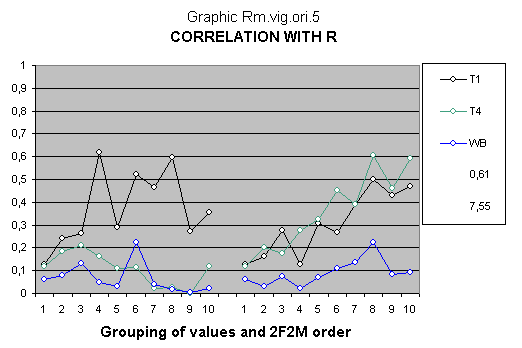
In order to be sure of the behaviour foreseen by the GIV method as part of nature of intelligence, we are going to use a special rearrangement criterion: the opposed order of M1F1, that is to say, the order of the vector formed by the grater values of M2 and F2, that we will call 2F2M.
| Arrangement Order |
Objective function |
|||||
R |
M & F |
|||||
| Graphics | GMCI | r² max. | Graphics | GMCI | r² max. | |
| 3 - Original variables T1, T4 and WB | ||||||
| M | q031 | 8,48 | 0,61 | q032 | 9,16 | 0,69 |
| F | q033 | 9,44 | 0,59 | q034 | 12,52 | 0,78 |
| 2F2M | q035 | 7,55 | 0,61 | q036 | 10,25 | 0,73 |
| 4 - Centred variables T1-d, X3 and X6 | ||||||
| M | q041 | 11,79 | 0,67 | q042 | 12,14 | 0,71 |
| F | q043 | 12,28 | 0,69 | q044 | 14,38 | 0,80 |
| 2F2M | q045 | 9,20 | 0,56 | q046 | 12,39 | 0,70 |
The result is substantially poorer with 2F2M than with the M1F1; therefore, we may assume more rigorously that the GIV method, or something similar, is operative in the inheritance of the characters associated to cognitive functions and is part of the nature of intelligence.
The precision of the results is really important if we want our interpretations to maintain a certain degree of confidence; when the lines corresponding to C variables and their different groupings follow a clear tendency we can assume that the results are not consequence of statistical coincidences. This fact is especially visible within the analysis of variables X3 and X6.
For the same reason, we have included another two rearrangement criteria in the analysis of the centred variables, that is to say, M and F.
For these two vectors, the result is superior compared to that obtained with variable 2F2M, but it continues being quite inferior in respect to M1F1.
The same comparisons can be made with original variables.
The different behaviour between M and F is a peculiar subject because up until now there were no indications for it. As we can see from the graphs, vector M seems slightly more significant as rearrangement criterion whereas its correlation with X3 and X6 was smaller than vector F. Regardless of the correlation level of M and F separately, it seems as if their lines or curves were mirror images of one another. This would be a change!
Sociologically speaking, this subject of the nature of intelligence and mirrors has always been very sensitive between M and F. I think that when the first humans realized that women always had the children, there were great and violent discussions about the importance of matriarchy, especially, in its economic aspect.
|
|
|
Mª José T. Molina |
Global Cognitive Theory |
Other books
|