Molwickpedia
Museum of the science of future
Philosophy of evolution, history and life

IQ evolution

The simulation of the evolution of intelligence confirms the results about the hereditary nature of intelligence. Also shows the genetic problems of the evolution of intelligence.

 
THE EDI STUDY

EVOLUTION AND DESIGN OF INTELLIGENCE

Global Cognitive Theory Mª José T. Molina
 

6. STATISTICAL SIMULATION: GLOBAL MODEL

6.a) Computer simulation of the evolution of intelligence  

  • Actual values and observed values!

The properly reformulated Individual model or Social model of evolution of intelligence has been useful to determine that the significant gene is the one of less intellectual powers.

Due to the accuracy of the Social model of evolution of intelligence, and the fact that I had all the elements to simulate the proposed model by the General Theory of Conditional Evolution of Live (GTCEL), I thought it would be a good idea to make a computer simulation of it in order to confirm the results. The statistical simulation should generate artificial intelligence quotients that should behave like those observed.

The second big surprise, for me, was the initial failure of the simplified Social model of evolution of intelligence to obtain this objective of statistical simulation of processes and mechanisms of biological inheritance.

This task was much more complicated than I thought, forcing me to eliminate all the simplifications that I had introduced in the Social model of evolution of intelligence.

The typical result of the generated variable W can be seen in the q050 graph. Considering that W is a random variable, the graph represents the average of ten estimates for the corresponding correlations.

The MCI of the artificial intelligence quotients vector W, which has been multiplied by 3 for comparative reasons, is over 25 and far above the G-MCI for the observed C variables of the children.

Statistical simulation model
Evolution of intelligence
Complex model with random deviations  Evolution of intelligence with VIG method

Earlier, we commented that the differences in IQ measurements of the same children were very high. In addition, that this was surely due to the manifestation of the child's capacity at any given moment, and even more so, over the years.

Other factors causing the same type of deviations are the particular intelligence test used and each specific test session within a standard test.

Consequently, we can introduce an additional combinatorial algorithm of the statistical simulation models to represent a factor of randomness based on these causes of the evolution of intelligence. Although the observed differences are superior to 10% in respect to the average in some cases, I will introduce a mean deviation of 3% upward and 3% downward.

For the same reason we introduce elements of error in children variables C, we should set an error pattern in M and F variables.

Nevertheless, the high correlation of W in computer simulation of the evolution of intelligence does not decrease substantially and do not behave as the original IQ vectors, like those from Stanford Binet test o Wechsler intelligent test.

6.b) Statistical simulation model: complexity and optimization 

It is necessary to introduce more combinatorial algorithm to represent other error patterns or the complexity of the statistical simulation model of evolution of intelligence to be able to qualify the model as acceptable. Nevertheless, it is not so easy, since it must lower the correlation in the unordered groups, mainly in the small groupings.

At the same time, in the previously rearranged groups the correlations should decrease in the small groups and increase or remain the same in the big ones. Once, we achieve a good model specification for the evolution of intelligence we could begin its optimization.

6.b.1) Genetic affinity  

First of all, we should try to eliminate the simplifications carried out in the model's theoretical argumentation to avoid its complexity.

In order to continue lowering the multidimensional correlation index of W, we may include the interesting filter effect mentioned by the General Theory of Conditional Evolution of Life (GTCEL) in the statistical simulation model of evolution of intelligence regarding the resulting intellectual power of the genetic combination. It will be equal to the intersection of the potentials and not to the potential of the smaller gene.

Of course, this decrease due to the lack of genetic affinity will not definitely be fixed in all cases and, for that reason, we will treat it in the statistical simulation as a random pattern; another margin of 3% upwards or downwards can be introduced bearing in mind the possible drag effect of ancestors.

After considering this filter effect, or affinity, the correlation has lowered again, but not much. And the complexity of the statistical simulation model continues to increase.

6.b.2) Sensitivity analysis - Globus Model  

Another oversimplification refers to evolution itself. The General Theory of Conditional Evolution of Life (GTCEL) indicates that genetic modifications indeed exists, that intelligence increases throughout life by means of internal work, and, that it is transmitted to descendants. So, I will introduce this improvement in the simulation model. Complexity will increase while introducing its correspondent combinatorial algorithms of error patterns.

Internal evolution
Genetic evolution of intelligence  Evolución genética de la inteligencia

We also have the possibility of introducing asymmetric combinatorial algorithms to help the statistical simulation models of evolution of intelligence achieve its goal of decreasing the MCI. Complexity increases again. Internal evolution will only take place in the male genes; they are the ones that are renewed constantly during a lifetime. I am sorry, but the General Theory of Conditional Evolution of Life (GTCEL), according to what I was taught in biology when I was little, reminds me that the ovules are fixed from a very early age in girls.

In addition, by following the model of evolution of intelligence, we can distinguish between direct and indirect internal evolution; in the former, the capacity will be increased in a percentage of its own value while in the latter, the increment will be a percentage of the capacity of the other gene or, better said, chromosome. This will imply an additional asymmetry and will make the correlation drop a little more than only the internal evolution.

The computer will make all the calculations of the necessary combinatorial algorithms in statistical simulation model. At least, math complexity will not be a problem.

A logical factor of minimum internal evolution was also checked; it was discarded due to the bad adjustments obtained.

Statistical study
Globus parametrized model

Variable X3
q073°
Variable X6
q076°
sexual selection & X6
q077°
Super Globus Model

TABLE: INTERNAL EVOLUTION SENSITIVITY 

Parameters
Internal Evo.°
T1-d, X3 y X6 and arrangement criterion M1F1°
Objective function
Direct Indirect M & F
Mothers Graphs GMCI r² max. Graphs GMCI r² max.
5 5 q071° 14,14 0,72 q072° 14,46 0,72
3 3   14,21 0,82   14,81 0,82
1 1   13,49 0,80   13,89 0,80
Null            
0 0 q023 14,98 0,92 q024 16,07 0,92
Fathers            
1 1   14,06 0,83   16,10 0,87
2 3   14,79 0,87   16,10 0,87
3 3   15,33 0,84   16,47 0,84
4 4   15,09 0,84   16,73 0,84
5 5 q063° 15,61 0,89 q064° 17,77 0,89
6 6   14,30 0,95   16,74 0,95
7 7   13,25 0,83   15,56 0,83
° Internal evolution parameters affect the objective function R and M1F1 order

Considering that internal evolution parameters will affect the objective function and variable M1F1° of the sample's previous arrangement, the effect on the correlations of changes in these parameters would allow us to see changes in the goodness-of-fit of this model's specifications. Using sensitivity analysis of these parameters of the model, not of society, it will allow the optimization of this magnitude.

The optimization with original variables is not as conclusive as with centered variables, these ones generate more precise results.

Evolution of intelligence   Evolution of intelligence graph

The graph shows the optimization done and that the best adjustment is obtained for a value of 5% for each of the parameters of internal evolution, direct and indirect. This means 10% in each generation of male genes. It would be a good idea to emphasize that in the initial General Theory of Conditional Evolution of Life (GTCEL) description, 10 years ago, I did mention a figure of 10% while talking about internal evolution.

Although more studies with more data are strongly recommended due to the complexity of the model of evolution of intelligence and all the combinatorial algorithms of error patterns, the difference in the MCI-Gs is, in my opinion, sufficiently noteworthy. I would also like to comment that each point of this graph represents 30 determination coefficients, r², between variables M & F and the average of variables C, and those deviations are compensated not only for the centered children variables C but also for the rearranged grouping.

Statistical simulation model   Algoritmos of optimizatation

Given the high degree of social sensitivity in these scientific areas, I would like to stress that I checked within the statistical simulation model whether the opposite assumption of male-female evolution would work in the same fashion; in other words, supposing that only females changed genes. In the same graph the results of the optimization are shown: as I expected the adjustments are even worse than in a no-evolution situation.

It is interesting to examine the X3 and X6 variables separately. Doubtlessly, X6 should present better results as the deviations of the natural combinatorial algorithms are more compensated.

The observed peak for the null evolution or the equivalent, that both sexes would contribute the same percentage to internal evolution has a really difficult explanation. I think we need to use complexity science within a quantitative approach; among others, I can think of a precarious idea: the possibility that not all men carry out the improvement of their genes due to a lack of confidence in Nature when determined indicators are present.

In this assumption, given the model sensitivity and the standardized variables, the first evolutionary increase of one percent would shrink the correlations, whereas when we approached the optimal value, the effect of a correct percentage of internal evolution would surpass the previous one.

Anyway, the optimal amount of 5% of direct internal evolution and the 5% of indirect internal evolution, of the capacity transmitted by men's genes is fairly clear.

The subject is not as serious as it seems socially if one knows or remembers what the GTCEL says about the meaning of sexual differentiation, specialization, etc. Women have the important and difficult task of the initial development of children that implies a biological specialization in technology of materials.

For that reason the parameter of endogenous external evolution is included in the statistical simulation model: it gathers the evolutionary effect generated by women, and in particular, it could imply an average of increase of 5% with random distribution. This, however, cannot be verified at the moment since its variation affects neither the objective function R nor the criteria of arrangement M1F1.

Another logical point is that the increase generated by men also comes from certain changes due to the improvement of available materials thanks to the amelioration in the quality of their formation when they were in the womb.

On the other hand, it is very possible that women's genes have a backup function in order to maximize the guarantee of the viability of the new being. On the contrary, Nature would be the first good programmer who would not make copies of her marvelous codes or programs once they have acquired a certain degree of complexity and accumulated work.

In fact, this result about evolution parameters is the most outstanding one of this study. I would say that, if it cannot be refuted, it should be accepted the General Theory of Conditional Evolution of Life, at least, in its main idea of the existence of a finalist evolution and the abandonment of the theory of random mutations and, consequently, of natural selection as the main mechanism of the evolution.

6.b.3) Genetic problems 

  • Functional limitations!

Despite other achievements, until now, the MCI of W has not been lowered enough.

Something else is definitely needed to diminish the correlations sufficiently. Finally, after studying different possibilities of changes in the model, I have decided to introduce what I denominate functional limitations due to various causes, especially in the mechanisms of the initial development of the intelligence.

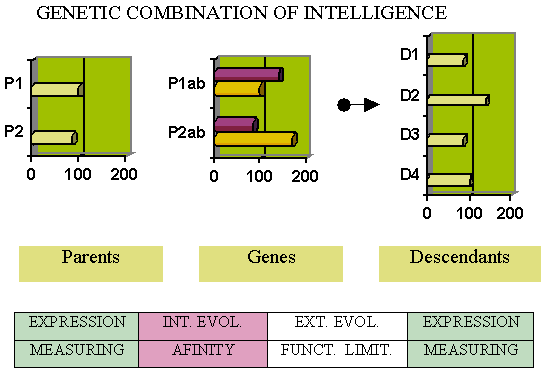
To place them in some step of the whole process, after the Mendelian genetic combination and with the filter of genetic affinity, we can assume that some genetic problems may occur, diminishing the expected intelligence quotient (IQ) 30 points. I say 30 points because it is the amount that has given the optimization of this parameter using the sensitivity analysis within the statistical simulation model of the evolution of intelligence.

Logically, there must be previous limitations or genetic problems that they do not reproduce in the following generation; so it is necessary to include sudden increments in IQ of half of 30 with the same probability of occurrence. I say half because the effect on the final capacity would be conditioned by the capacity of the other gene, taking into account the presence of the GIV method.

By the way, these functional limitations or genetic problems were already predicted in the GTCEL evolution model about the nature of intelligence, although there was no special mention of them in order to simplify the presentation. However, they did appear, in all clarity, in the simulation of the evolution incorporated in the Esnuka program (1992) following the General Theory of Conditional Evolution of Life (GTCEL) guidelines.

The evolutionary theory game Esnuka instructions say: "the black or white circle in the middle of the ball represents the number of fouls accumulated by the player. The genes are carriers of these fouls and, as such, can change through evolutionary processes. Furthermore, the number of fouls represents the probability of a genetic accident throughout these steps; an accident means the player is reduced to the lowest state within the scale."

In agreement with the nature of intelligence according the evolutionary theory game Esnuka and with the statistical analysis, these functional limitations or genetic problems will appear once every five times in the negative sense, and once every five times in the positive sense, but with half the intensity.

Genetic problems
(Public domain image)  Genetic problems

The explanation of the existence of these functional limitations or genetic problems can be diverse; the following are among the probable causes:

  • Not all intelligence functions are on the same chromosome or portion of DNA, following the Mendelian genetic combination. This causes additional discontinuities in the final determination of the intellectual ability.

  • There is the necessity of specific materials in initial development, for example, food craving during pregnancy. Everybody does not have same power to produce proteins; lacking some of them could cause the no-expression of the genetic information; again, this could provoke gaps regarding cognitive abilities transmission.

    The conclusions of the study about discriminating pre- and postnatal factors, from the Medical School of the University of Pittsburgh would fit perfectly here. In my opinion, these factors are part of the structural development of intelligence and I would never classify them as environmental factors in a strict sense. In other words, the technology of materials is of genetic nature; another matter is the need for the necessary elements at every moment, and the lack of these elements will not usually be the case.

    In the end, everybody needs to have his or her bag of tricks.

  • Being complementary with memory or other functions.

  • Genetic accidents in the broadest sense, including precautions anticipated for special cases with certain risk factors.

  • Real paternity!

  • Environment. It should be assumed to have some influence, even if it is small!

  • ...

From another point of view, it would be feasible to say that the effect of these genetic problems or functional limitations, up to a certain point, would be similar to that popular phrase the black sheep of the family.

The q060 graph shows the final result of the Global model, with the addition of the genetic problems and adjusted with the average of ten W variables; the accuracy of the adjustment can be observed both visually and by the level of the MCI of W (16.85) that has been reduced to levels of the global MCI (15.61)

6.c) Esnuka evolutionary theory game 

After introducing the functional limitations with a 30-point level, the Global model of evolution of intelligence works satisfactorily which can be verified with the images associated with the following tables.

The third surprise has been that the complete model contains exactly the same parameters as the evolutionary theory game Esnuka (1990) about the biology, evolution and genetic problems regarding the nature of intelligence. I relinquished introducing some of them in the simple model because I did not think that they were necessary and I thought that it would be very difficult to justify their presence in a statistical study.

In fact, to prove the hereditary nature of intelligence, the Global model does not need either a simulation or the generation of the objective function R if the adjustments are made directly on M and F.

Evolutionary theory game Esnuka is a billiards program in which the colors of the balls depend on evolutionary states based on the obtained cannons, in agreement with the postulates of the evolutionary theory GTCEL. In the simulation game Esnuka not so many random variables need to be assumed because the computer does not produce errors in the expression or in the measurement, and the evolution takes place with a constant percentage once the corresponding parameter is fixed.

All the graphs correspond to the Global model of evolution of intelligence including functional limitations. Of course, to obtain a satisfactory optical effect, the images have been chosen where W shows better adjustments to one of the C variables of the children.

6.c.1) Original variables 

The original individual variables do not always improve their adjustment within the statistical simulation of the Global model of evolution of intelligence, whereas the centered variables do. For rearrangement criterion (M+F)/2 this can easily be understood because this criterion does not respond to the changes in the parameters of internal evolution.

Statistical study 
5 - Global Model: T1, T4 and WB
Intelligent test of Wechsler and Stanford-Binet scales

Order Objective function
M & F
Graphs GMCI r² max. Graphs GMCI r² max.
(M+F)/2 q051° 11,73 0,62 q052 13,05 0,80
M1F1° q053° 10,91 0,79 q054° 13,04 0,79
q055° 10,83 0,73 q056° 12,63 0,94
WB q057° 12,26 0,89 q058 14,68 0,99
° Internal evolution parameters affect the objective function R and M1F1 order

A particular graph could only be affected by the evolution parameters when either the objective function or the rearrangement criterion is affected because the C variables of the children, mothers M and fathers F are observational variables. When variables are affected, the variables concerned are marked with a circle; therefore, when the column or row headings of next tables have an (°), it will indicate that the model adjustment has changed due to the evolution parameters effect.

Surely, some elements of the model may be improved upon, but the main structure of the model, in my opinion, is totally valid. Also it could be that these original variables, with so many deviations and in spite of the sensitivity of the Global model and the random variables, are not capable of detecting the limited effect of the internal evolution parameters.

It is too soon to make very specific conclusions; for example, sometimes the three C variables behave similarly and sometimes very differently. It is possible that the different IQ tests employed measure different characteristics and therefore, respond differently when the perspective of the analysis changes.

We already knew the diversity of the data source. What would be new is the quantitative analysis from these perspectives.

In other words, it could be that certain elementary functions of intelligence belong to a hard nucleus that will not be affected normally by the internal evolution of a single generation. I am sure that a constant of minimum human intelligence will signify an improvement of the goodness-of-fit of the model; in particular, I think that this minimum would be around 50 or 60 points, although there will always be exceptions by serious cerebral alterations of some individuals.

Even so, the correlations obtained with the individual variables achieve correlations of 0.89 for function R° defined by the GTCEL and of 0.99 for M & F. This last result, however, is the same as with the model without evolution because the parameters of the model do not alter M & F or the criterion of arrangement WB.

Also, when variable R° is used as an arrangement criterion, it obtains a correlation of 0.94 which it is not at all bad, and 0.79 for both objective functions when the criterion is M1F1°.

Of course, we cannot forget about the impressive behaviour of variable W in all of them. I really think that the visual effect of the graphs strongly accounts for the high-quality specifications of the Global model.

6.c.2) Centered variables 

Centred variables maintain a better adjustment in relation to the original ones.

It could be said that the graphs of the Global model of evolution of intelligence are speak for themselves.

Statistical study
6 - Global Model: T1-d, X3 and X6

Order Objective function
M & F
Graphs GMCI r² max. Graphs GMCI r² max.
(M+F)/2 q061° 14,70 0,77 q062 16,03 0,80
M1F1° q063° 15,61 0,89 q064° 17,77 0,89
q065° 15,55 0,84 q066° 17,40 0,97
X6 q067° 15,05 0,91 q068 17,20 0,88
° Internal evolution parameters affect the objective function R and M1F1 order

In comparison to the same centered variables without internal evolution, the GMCI increases more when the objective function is M & F than with R°; although it is important in both. Also, the GMCI increment is bigger with criterion M1F1° than with R°, with 1.70 and 1.52 points respectively.

For both objective functions R° and M & F the results are enhanced when the criteria of arrangement R° and M1P1° are used.


© 2002, All rights are reserved

Thanks very much for your visit,
your comments, wikitos
and laikitos!

 
The EDI Study