
4.c) Genetic variability
The main reason for proposing a new theory of evolution is the different approach to the origin and sources of genetic variability.
While for the Darwinian theory, the genetic variability is due to random mutations, for the Conditional Evolution of Life –CEL– it is not possible only this character of the genetic variations, bearing in mind the complexity of the living beings and their quick evolution.
The behavior of animals is always logical because it is the product of an evolutionary strategy.
El País 02-10-2002. Congreso Nacional de Etología
These ideas about complexity in evolutionary biology appear in the objectives of the evolution section.
Current genetic regulation is similar to modifying a computer program without knowing its full structure, functions, or program language. The intention is not to exaggerate the risks involved in genetic engineering, they undoubtedly exist, but they should be minimal.
When a program is modified, it may stop working, but it is challenging to create a computer virus by accident. With random variability, the new being would not be viable, but that is all. Genetic problems designed deliberately for a bacteriological war would be a different issue.
Sydney Brenner
Nobel Prize in Medicine 2002
“We know almost nothing about the human genome.”
El País 18-09-2003.
Likewise, the more we know about how DNA works, the more it looks impossible for the complex systems to result from random genetic variability.
The random character of genetic variability is due to not understanding their cause and full functionality. The unknown is usually random for pure conventionalism.
4.c.1. Concept of gene
There is a problem in the terminology of evolutionary biology and genetic variability because it usually has the meaning of the Darwin theory of evolution.
The first precision is that we refer to the genetic information that has been or will transmit to progenitors or descendants.
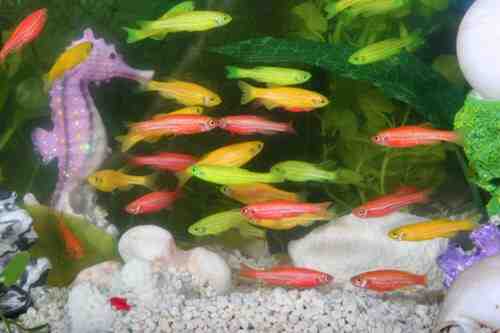
Danio Rerio (Public domain image)
This restriction is crucial, given that almost all cells contain an individual’s genome. A genetic modification that originates in a cell ** not always have reproduction functions. The concept used here includes these changes insofar as they end up moving to the reproductive system in any possible way.
Logically, academia does not admit this approach.
Something else that needs to be clarified is using the expression changes in a gene or similar; it refers to expressions like modifications to genetic code passed on to descendants to avoid repeating it too often.
We will avoid this practice as far as possible. Sometimes, it simplifies the reasoning; it will even refer to genetic information in different genes when it is not relevant.
The concealed face of the genome
Nowadays, it is challenging to provide a precise definition of a gene.
We have genes from DNA that produce proteins and RNA genes that do not encode proteins.
The RNA molecules are pieces of a jigsaw puzzle that make up an unknown image.
El País 10-09-2003.
Usually, it seems genetic information and variability are something very complicated: DNA’s tridimensional molecular structure. Here, the idea is just the general concept of code regardless of its chemical mechanisms.
This study is a functional analysis and not of biochemical composition. Therefore, genetic information could be like the following examples.
Source code of a computer program
Technical definitions buildings
Technical definitions of a car
User instructions of a computer program
4.c.2. Types of genetic variability
Let us see some of the multiples classifications that could appear in evolutionary biology:
- Genetic variations derived from the objectives of the evolutionary system
- Improve the efficacy
- Improvement characteristics of materials: new proteins
- Rationalization and simplification of the structure of the genetic code.
- Improve the functionality of any element of the genetic information.
- Guaranty and security
- To create different genetic variations to deal with changes in the environment.
- Associate the idea of structural genetic information to some of it to know the consequences of any future change or variation.
- Keep genetic code not operative for possible future utilization
- Cohesion and compatibility
- Associate the condition of Logical Verification of Information with the other progenitor's genetic information in sexual differentiation.
- Balance development of genes with complementary characters.
- Optimization
- To make risky modifications relying on the mechanism of natural selection.
- To make chancy alterations counting on the use of the method of Logical Verification of Information.
- Genetic variations to improve the use of the resources
- Improve the efficacy
- Depending on the methods of genetic evolution
- Trial and error
- Natural selection
- Thorough testing
- Partial testing
- Initial endogenic sexual differentiation and other variants
- Sexual differentiation
- External Logical Verification of Information
- Backup or historical archives
- Cause of genetic variability
- Accidental or random mutations/ directed
Internal/external (to the individual)
The first would be the group of improvements made to the genetic code, produced due to the individual’s learning, working, or life experience previous to genetic information transmission.- Endogenous (to the genetic system) / exogenous (environmental)
- Nature or expression
- Operative code / not operative (genetic garbage –Not a very good term)
- Discrete / continuous
- Restrictive (Conditions of external verification...) / additive / special
- Variations of genes with complementary character / independents / dependents.
- Immediate / not immediate (confirmation needed in next generations)
- Initial moments (of the new being) / posterior
- Visible (macro scale) / not visible (micro scale)
NEWS ABOUT THE THEORY OF EVOLUTION
Junk DNA comes to light.
The first surprise is that the so-called “genetic garbage” has been incorrectly named: 80% of DNA turns out to have some biochemical function. Moreover, 95% of DNA affects the regulation of healthy genes.
El País 06-09-2012
- By the mechanisms of genetic variability
- Random / design
- Predetermined random between fixed options / Entirely random
- Simple / complex