
Molwick free online books - Philosophy of evolution, science and life.

Multiple intelligencec, intuition and creativity.

GLOBAL MODEL OF INTELLIGENCE

The computer simulation within the Global model should generate artificial intelligence quotients that should behave like those observed
  The computer simulation within the Global model should generate artificial intelligence quotients that should behave like those observed


Online book of The EDI Study on experimental psychology. Statistical study with IQ test data about the nature of intelligence.


STATISTICAL GRAPH

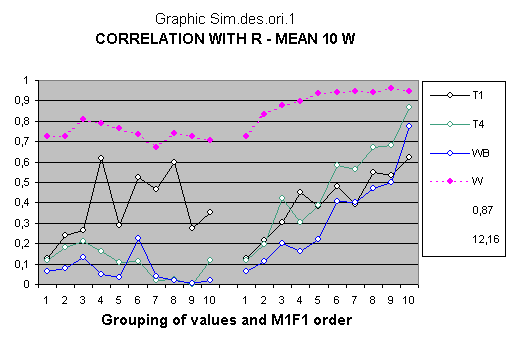
The title of each graph of the of the statistical study indicates the parents variables (R or M & F) to which the correlations are related. These correlations are represented by each point of the coloured lines corresponding to each examined C variable (children).

Likewise, the variables of unknown order, formed by the different groups of 1 to 10 values from the 70 IQ values of each parent and children variables are placed on the left hand side of the graph. The groups of 1 to 10 values located on the right hand side have been previously ordered with the variable mentioned at the bottom of the graph.

Indeed, an almost instantaneous perception of the exactitude of the particular specification of the statistical study is obtained; sixty coefficients of determination (r²) are shown in a way that highlights the global and underlying relations of the involved data set.

See the methodology of the statistical abstract for more details

DATA SOURCE AND VARIABLES OF THE STATISTICAL MODEL

* R ° The objective function R of the statistical study is determined in accordance with the General Theory of Conditional Evolution of Life (GTCEL), Mendelian genetics significance and applying the Verification of Genetic Information method (VGI) to the intelligence quotients of the mothers (M) and fathers (F). Function R is the mathematical expected average of the genetic ability of the children in agreement with the GTCEL and it will be the sum of the expected averages of each one of the cases weighed by their probabilities according the Mendelian genetics.
M & F The two IQ vectors are use simultaneously in statistical regression using ordinary least squares with one IQ vector of the children.
T1 IQ vector of children - Original variable from the Young Adulthood Study - Stanford-Binet intelligence test.
T4 IQ vector of children - Original variable from the Young Adulthood Study - Stanford-Binet intelligence test applied when children were 12 years old.
* WB IQ vector of children - Original variable from the Young Adulthood Study - Wechsler Bellevueintelligence test applied when children were 13 years old.
W °

The development of artificial intelligence quotients vectors is curried out by the computer simulation of the General Theory of Conditional Evolution of Life. They should behave like the observational data source.

* (M+F)/2 Vector of IQs are produced by the semi-addition of the intelligence quotients of the mother M and the father F.
* M1F1 ° Vector of IQs obtained with the lowest value of M and F of each family, either the intelligence quotient of the father or the intelligence quotient of the mother.

STATISTICAL MODEL COMMENTS

1. General statistical significance

The great increase of the correlation for the estimation of homogenous groups cannot be imputed to the reduction of 68 to 5 or 4 degrees of freedom, since the estimation with non-homogenous groups, without previous rearrangement, has the same degrees of freedom and the correlation even lowers with respect to the sample without grouping.

When the model of the statistical study has more freedom with the two intelligence quotients' variables, M and F, either it definitely adjusts better by statistical effect or the statistical data set we have available is a particular case.

In general, the model of genetic evolution of intelligence (Mendelian genetics and GTCEL) adjusts perfectly, showing an superior to 0.9 in several cases. Bearing in mind the tendency to increase the goodness of fit with the size of rearranged groups, we could asume it would be over 0,9 in almost all the cases for groups bigger than 20, of course, it should be needed a bigger sample...

2. The Global model - Statistical model on simulation of evolution with artificial quotients of intelligence.

We could say the Social model of evolution of intelligence resolves the debate heredity vs. environment. It shows that there is not much margin left to deny the hereditary nature of intelligence, not even to try to reduce it to less than 80%. Of course, one could always argue that there is a problem with the concept of intelligence and why not? with the definition of environment.

The main goal of this statistical model was not to resolve the debate heredity vs. environment but to go further and demonstrate the operational existence of the genetic information verification method (GIV) pointed out by the GTCEL (General Theory of the Conditional Evolution of Life) for the intelligence particular case.

Also, the Social model of evolution of intelligence has been useful to determine that the significant chromosome is the one of less intellectual power.

Due to the accuracy of the statistical model, and the fact that I had all the elements to do its computer simulation, I thought it would be a good idea to use it in order to confirm the results in despite the complexity of the task..

The computer simulation within the Global model should generate artificial intelligence quotients that should behave like those observed. This task was much more complicated than I thought, forcing me to eliminate all the simplifications that I had introduced in the model design.

Finally, after introducing the functional limitations, the Global model works satisfactorily which can be verified with the images associated with the graphs.

Of course, to obtain a satisfactory optical effect, the images have been chosen where W shows better adjustments to one of the C variables. It could be said that the graphs are speak for themselves.

Comparing the statistical correlation an regression with original variables and with centred variables, the GMCI with centred variables is higher in both cases and increases more when the dependent variables or objective function is M & F than with

The statistical study of the Global model absolutly confirms the results of the Social model about the hereditary nature of intelligence.

3. Significant figures of this particular graph of the statistical model.

The typical result of the generated variable W before eliminating the simplifications can be seen in this graph. Considering that W is a random variable, the graph represents the average of ten estimates for the corresponding correlations.

The MCI of the artificial intelligence quotients vector W, which has been multiplied by 3 for comparative reasons, is over 25 and far above the G-MCI for the observed C variables.

The theory of intelligence in the Global Cognitive Theory. Definition of intelligence as the group of basic and abstract relational functions of the brain.
 
Google Groups: Equilibriums