
Molwick free online books - Philosophy of evolution, science and life.

Multiple intelligencec, intuition and creativity.

GREGOR MENDEL GENETICS AND IQ

Statistical study about Gregor Mendel genetics with IQ vectors of Stanford Binet and Wechsler IQ test
  Statistical study about Gregor Mendel genetics with IQ vectors of Stanford Binet and Wechsler IQ test


Online book of The EDI Study on experimental psychology. Statistical study with IQ test data about the nature of intelligence.


STATISTICAL GRAPH

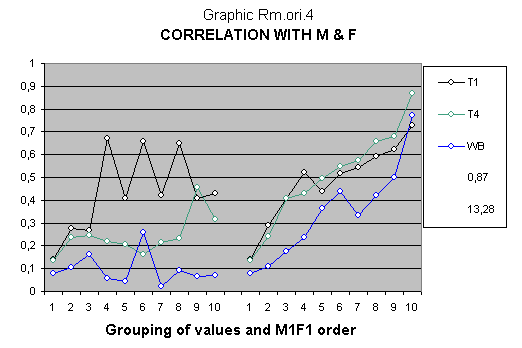
The title of each graph of the of the statistical study indicates the parents variables (R or M & F) to which the correlations are related. These correlations are represented by each point of the coloured lines corresponding to each examined C variable (children).

Likewise, the variables of unknown order, formed by the different groups of 1 to 10 values from the 70 IQ values of each parent and children variables are placed on the left hand side of the graph. The groups of 1 to 10 values located on the right hand side have been previously ordered with the variable mentioned at the bottom of the graph.

Indeed, an almost instantaneous perception of the exactitude of the particular specification of the statistical study is obtained; sixty coefficients of determination (r²) are shown in a way that highlights the global and underlying relations of the involved data set.

See the methodology of the statistical abstract for more details

DATA SOURCE AND VARIABLES OF THE STATISTICAL STUDY

* R ° The objective function R, determined in accordance with the General Theory of Conditional Evolution of Life (GTCEL), genetics of Gregor Mendel significance and the method VGI applied to the intelligence quotients of the mothers (M) and fathers (F). Function R is the mathematical expected average of the capacity of the children in agreement with the GTCEL and it will be the sum of the expected averages of each one of the cases weighed by their probabilities according the genetics of Gregor Mendel.
M & F The two IQ vectors are use simultaneously in statistical regression using ordinary least squares and one IQ vector of the children.in statistical regression with ordinary least squares and one IQ vector of the children.
T1 IQ vector of children - Original variable from the Young Adulthood Study - Stanford-Binet intelligence test.
T4 IQ vector of children - Original variable from the Young Adulthood Study - Stanford-Binet intelligence test applied when children were 12 years old.
* WB IQ vector of children - Original variable from the Young Adulthood Study - Wechsler Bellevueintelligence test applied when children were 13 years old.
* (M+F)/2 Vector of IQs are produced by the semi-addition of the intelligence quotients of the mother M and the father F.
* M1F1 ° IQ vector obtained with the lowest value of M and F of each family, either the intelligence quotient of the father or the intelligence quotient of the mother.

STATISTICAL STUDY COMMENTS

1. General statistical significance

The great increase of the correlation for the estimation of homogenous groups cannot be imputed to the reduction of 68 to 5 or 4 degrees of freedom, since the estimation with non-homogenous groups, without previous rearrangement, has the same degrees of freedom and the correlation even lowers with respect to the sample without grouping.

When the model of the statistical study has more freedom with the two intelligence quotients' variables, M and F, either it definitely adjusts better by statistical effect or the statistical data set we have available is a particular case.

In general, the model of genetic evolution of intelligence (genetics of Gregor Mendel and GTCEL) adjusts perfectly, showing an superior to 0.9 in several cases. Bearing in mind the tendency to increase the goodness of fit with the size of rearranged groups, we could asume it would be over 0,9 in almost all the cases for groups bigger than 20, of course, it should be needed a bigger sample...

2. Statistical study of genetics and intelligence with the Social Model and original variables.

The results of the Social model of evolution of intelligence following genetics of Gregor Mendel and the General Theory of Conditional Evolution of Life (GTCEL) are surprising, which can be observed both in the statistical graphs and in the table resume. An aspect that will especially allow us to reach some important conclusions is the model sensitivity of the arrangement criterion.

Also, it is interesting to verify the fact that the objective function R is almost as powerful as variable M of mothers and F of fathers together.

The Social Model of this statistical study has been examined in its double formulation, on one hand, calculating the correlation with respect to the objective function R, determined in accordance with genetics of Gregor Mendel and the General Theory of Conditional Evolution of Life (GTCEL). On the other hand with respect directly to the variables Mothers (M) and Fathers (F), estimating the model with the method of the ordinary least squares, allowing for a comparative analysis between the two formulations.

The groups located on the right hand side have been previously ordered with the variables mentioned at the bottom of the graphs. (*)

The effectiveness of the compensations of deviations from genetics of Gregor Mendel and differences due to the expression and measurement of the IQ in C variables will be optimum.The groups divided in stratums will allow for a suitable adjustment of the tendency or relation between the variables of the model.

Variables *(M+P)/2, *M1P1 and *R are similar while variable *WB adjust better when is used to rearranged the groups.

Variables *M1F1 and *R only incorporate, so far, the partial effect of the genetics of Gregor Mendel and, therefore, variable *WB (Wechsler intelligence test) is a better order criterion. Nevertheless, this does not take place in all cases; it is definitely a consequence of the incorporation of the differences due to the expression and measurement of the IQ in C variables, which does not happen with variables *M1F1 and *R.

An interesting aspect, in which I haven’t gone into much depth, is the different form of the value graphs without previous arrangement, the T4 and WB on one side, and the T1 on the other. The correlations of the later displays the common saw-tooth forms of the arranged values with greater clarity but without the rising tendency.

It’s as if there were uncollected deviations only in the T1 variable of the children which is compensated for to a great extent and therefore should be random and, at the same time, is independent of the intelligence quotient (IQ) values. Perhaps it is due to the young age of the children when they took the intelligence test

The aforementioned deviation was produced for the correlation with the R function as a dependent variable and for M&F as dependent variables as well. Although, for the second case, the compensation is much more accurate and could show that, in some way, the information regarding this deviation is lost in the creation of the R function from the M&F variables.

Sorry for the complexity of these last paragraphs. Please, bear in mind that, although they involve a deep analysis, they are referred to marginal aspects of the statistical study and do not affect its main conclusions.

3. Statistical significant figures of this particular graph

As you can clearly see by its form, the three dependent variables of the children, analyzed in the model, behave in a very similar way to the progenitors' explanatory variables M & F

The general multidimensional correlation index (ICMG) is 13,28 which is relatively low. However, for groups of 9 and 10 values correlations are bigger than 0,7 in all cases.

The highest determination coefficient of this graph is 0,87 which is a significantly high value for the generally acepted value in other works about intelligence heritability.

The theory of intelligence in the Global Cognitive Theory. Definition of intelligence as the group of basic and abstract relational functions of the brain.
 
Google Groups: Equilibriums