9.b.1. Lamarck's theory of evolution
Lamarck's theory of evolution appeared in his Zoological Philosophical Work written in 1809.
His evolutionary theory was as follows:
- Environmental changes generate new needs
- These needs determine the use or disuse of some organs
- Such organs develop or weaken
- The acquired characters are hereditary
Therefore, this theory of evolution is also a theory of human origin.
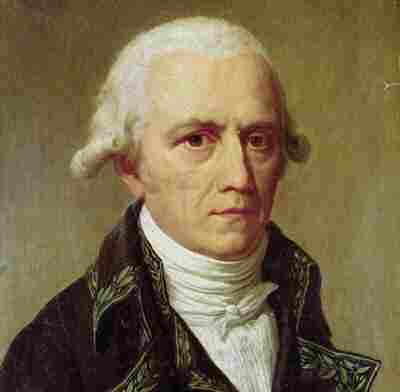
Lamarck (1744-1829) (Public domain image)
Lamarck's Theory of evolution's famous expression is that functions create organs, and heredity determines the change in offspring. Therefore, the human origin is monkey thinking.
A typical example of Lamarck’s theory is the evolution of giraffes' necks due to the trees' eating leaves.
See chapter III about criticism of Lamarck's theory
9.b.2. Theory of evolution of Darwin
This point refers to the biological theory by Charles Darwin, the English Naturalist, in his main work, The Origin of the species, in 1859.
In contrast to Lamarck's evolutionary theory, Darwin's theory proposed natural selection based on development and human origin. His approach was as follows:
-
Individuals display differences
Shortage of food leads them to fight for existence
Individuals with superior differences have more chance to reach adulthood, reproduce and transmit these variations to their offspring
From a philosophical point of view, the Theory of Natural Selection of Darwin base on emergentism.
Later, in his The Origin of Man and Sexual Selection (1871), he added a new evolution and human origin factor, sexual selection. Male or female chooses partners with more attractive qualities.
The scientific community generally accepted Darwin's ideas (in opposition to Lamarck's), as presented in his work The Origin of the Species in 1859. This theory adapts many times with scientific knowledge while keeping its essence: evolution is due to natural selection.
Accordingly, the genetic variations or genes are random mutations; their character is supposedly not directed.
See chapter III about criticism of Darwin's theory