
4.b.2.c) Dominant and recessive genes
The example of the brakes' evolution makes one reflect on the real nature and instrumental behavior of dominant and recessive genes.
Regardless of the molecular mechanisms, dominant and recessive genes are old-fashion and rather basic concepts. Let us see their function within the framework of genetic evolution.
Concerning the Mendelian genetics examples, the big question is which of the two genes would express and what happens if both parents' genes are dominant or recessive.
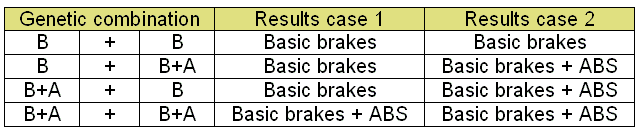
We should bear in mind that the concept of a dominant gene implies discrimination against a character in the new being. Therefore, the analysis includes the possible causes, which will finally lead to a better, faster, or safer evolution.
The next intuitive example of the Mendelian significance of dominant and recessive character uses the analogy within brakes' evolution in cars.
-
Two types of genes exist for a particular characteristic of our vehicle: gene type B and gene type B+A.
Gene type B contains the technical specifications for the car’s essential brakes.
- Gene type B+A also incorporates, as well as the car’s essential brakes, the technical specifications for ABS brakes (from now on referred to as ABS t.s.)
Regarding the significance and genetic expression, the possible Mendelian combinations of the two types of genes would be the following.
-
The dominant genes are the less evolved ones
Let us assume that in the event of faulty technical specifications –ABS t.s. – brakes, neither of the brakes system would work –not even the basic ones. However, it is imperative to guarantee the new car's commercial reliability –including the avoidance of accidents– that the brakes must always work –either the basic breaks or the basic + ABS.
Thus, when installing ABS brakes, there must be high reliability that the technical specifications are correct. Only comparing the technical specifications in both genes can ensure this. If they coincide, practically no fault exists, as it would be difficult for them to overlap in one particular flaw.
If one of the genes does not include ABS t.s. or if ABS t.s. appears in both genes but are not identical in both sources, the result will be a lack of ABS brakes. Therefore, in case 1, the dominant gene is type B because its presence forces essential brakes to develop.
Note that gene type B is the least evolved of the two in our example.
The dominant genes are the modern ones
In case 2, where, in the event of faulty ABS t.s., the ABS brakes cease to function, but the primary brakes are not affected. Therefore, the new vehicle will be reliable when including the ABS t.s.
Consequently, if there is only one B+A gene, the car would have ABS brakes, as it is just advantageous and poses no risk.
In this last case, the dominant genes are type B+A; because if it is present, it will always manifest itself, and it is still more evolved (modern) than type B.
As we can see, the dominant genes from the first case have become recessive, and the recessive genes dominant. It implies that a dominant or recessive character is relative to the functionality of the coupled source.
Now, adding a new gene type B+A+M. This new type has more modern (powerful) technical specifications than ABS. In case 1, we would find that gene type B+A would be a recessive gene compared with type B and dominant with type B+A+M. On the other hand, for case 2, type B+A would be prevalent with B and recessive with B+A+M.
In developing a new being, a genetic mark is necessary to establish a kind of behavior. An example of a molecular mechanism that allows mark incorporation could be the histones –pieces of DNA– studied by modern molecular biology.
A second question is whether the dominant genes compensate for the recessive genes, or only the dominant genes express. Again, the answer is, it depends. In case 1, due to the dominant character of type B, the result is basic brakes. However, both recessive genes could develop B+A breaks with positive verification.
In case 2, gene type B+A's dominant character develops the two brake types, and B's recessive traits, only primary brakes. Either way, in nature, it will come across all kinds of cases.
The above explanation is simple, although not as the old-fashioned concept of the dominant or recessive gene. However, it is much less simplistic than co-dominant and co-recessive, which continues not to argue why genes are dominant or recessive under different conditions.
“There are various ochre pieces carved with geometric motifs in a South African cave over the Indian ocean. This discovery leads us to believe that modern human behavior originated at least 77,000 years ago, during the African stone age.
Examples of the oldest artistic activity known until now, the cave paintings in Spain and France, were much more modern but also more convincing.”
El País 11-01-2002. Science / Journal of Human Evolution
Nowadays, academia supports the evolutionary process depends on a combination of random mechanisms and natural selection. This argument could apply to bacteria's evolution, bearing in mind that millions and millions of babies are born in short periods. Although they have been evolving for millions of years, their development has not been particularly significant.
The evolution of man has just been the opposite. Only 2.000 generations of human descendants (if one accepts that modern humans have only existed for 40.000 or 50.000 years). However, few children are born per generation, and the human brain's evolution has been enormous.
How many combinations of direct descendants would be necessary for the Windows 3.11 code to evolve into the Windows 95 using an evolutionary process based on random mutations?
How many combinations would be necessary for the technical specifications of standard car brakes to convert into ABS in cars’ evolution?
Perhaps philosophical ideas surrounding genetics and evolution should change to recognize the intrinsic dynamics of genetic development of vital impulse systems.