
4. Human brain memory
The memory manager –the intelligence– uses many methods and processes to classify, organize, and rationalize the information contained in the brain memory. We are going to comment on some great techniques.
4.a) Automatic memory and directed memory
Up until now, we have talked about the memory's automatic operation mechanisms; indubitably, we can influence which information to save.
It is nothing new the more someone studies a subject, the more retains. However, the operation of the transfer from short-term to medium-term memory is unconscious; the brain detects interest according to the number of times it has dealt with a subject.
A significant leap occurs when trying on different days to memorize specific information. The memory manager will then find references to the subject in the most superficial layers of medium-term memory, and there will be a tendency to save them more firmly; in other words, in the subsequent layers of medium-term memory.
Equally, if the memory manager requires information and realizes it is not complete, as better obtainability would be suitable, the brain will tend to improve the availability in the medium-term memory. It will also establish the data in the multidimensional system by creating opportune references.
In an exam, some artificial references for better information retention could significantly help medium-term memory. Specifically, we are referring to mnemonic devices.
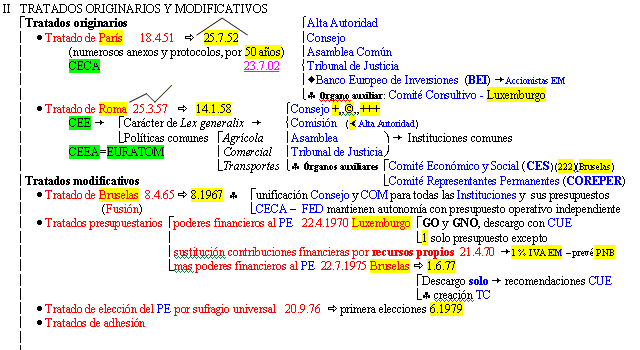
Useful examples are marking dates, figures, percentages, and related mathematical info with a particular color; authors, institutions, and entities with another color, and so on, but without using too many colors or other mnemonic devices! Maximum color should be four or five.
In any case, one should never force to remember mnemonic rules; whether they work well or not, they must be neutral and not stressing the memory. An example is a line drawn over the date 25.7.52 in the figure, which should help to retain this date but it should not be a necessary condition to remember it.
However, sometimes, despite our effort and knowing we are capable of remembering, it seems our memory does not respond. The most common reasons could be:
Not sleeping enough
Excessive consumption of alcohol, and to a lesser extent, tobacco
-
A true lack of interest
-
Being very tense when studying, this notably limits the capacity used by the memory manager either when awake or when sleeping.
- One is not going to use the information shortly or adequately. A typical example is the learning of languages we do not use or attempt to learn them in math memory because languages develop in semantic memory.
Do not confuse the tensions mentioned in the previous paragraphs with the situation of a student who has various exams close together or a test of a vast subject.
Before the exam, the students are nervous, excessively nervous, and they feel they know nothing. These nerves appear when short-term memory overworks for its normal state –demanding much effort; the nervous tension is probably the only way to allow this overload in these circumstances.
Consequently, we do not need to worry if the night before a test it takes to fall asleep a long time. The brain does not want to clean the short-term memory because it is full of information regarding the test, and it tries to avoid or reduce the phase of deep sleep.
We believe it is a mistake to study all night before a test because the connection between short-term and medium-term memory would weaken.
We also become more stressed when we cannot stop thinking about the exam's subject along with the feeling of not knowing anything.
However, once the questions are public, the tension disappears, and a multitude of concepts vanishes from the mind, filling up with related information. The more we think, the more information continues to appear; of course, if we are familiar with the subject.
It is worth pointing out the existing connection of reasons for the brain memory malfunctioning and dysfunctions in the decision-making system.
This coincidence could appear if every time we study a subject, we try to save it in a different group of references, consciously or unconsciously.
4.b) Pre-established logic blocks or structures
Talking about the development of fast responses of the intelligence, we stated brainpower notably increments with its automation. A reason was that new info goes directly in the prepared fields of the subprograms or functions, and once all the data arrives, the specific operation launches automatically.
In short, the process implies the creation of pre-established structures or fields for info treatment. These structures could be useful in the global system of information if the brain needs them for the storage.
The development and improvement of these structures can actively involve the person’s will. We call this guided memory.
Computer programs continually use this technique, organizing the data in groups of personalized fields to treat them as matrixes.
4.c) Only memorize what it is not logic
One of the memory manager's most efficient methods is a consequence of the rule of not remembering what can easily be deduced using logic. In this case, it means a specific personal idea associated with an event.
The trick is not to know, but rather to know what one knows; which is not the same.
We hope to explain ourselves better with a simple example in which we can answer one question without having any specific related information in our memory. The exception is that one has to know what one knows and what one does not know. (It will always be the same simple reference in long-term memory. Moreover, it will be a straightforward reference).
-
Question: Who has longer hair, Susana, or Julio?
Supposition 1: I have no link, no reference to this in my memory.
Answer: I do not know, I could imagine that, but I do not know.
Supposition 2: I know that I know because, in some way, this question (not the answer) has an associated reference in my medium-term memory.
Answer: Susana (It is assumed to be correct).
Let us see the following process: as I know that I know because my memory has told me so, I look for the specific logic that I would have applied to save this information.
In this case, it would be "normally, women have longer hair than men." Therefore, the answer is Susana.
The advantages of this scheme are, on the one hand, that the reference is elemental and already exists in medium-term memory; we only need to activate it for a specific case. On the other hand, when applying logic, there is no need to change the reference for the most common situations, which is what we would have done if Julio had longer hair –pointing to the opposite idea.
Here is another implication of this method: if we know what we know and we do not remember the reference's sign, by default, we will assume that this is the typical sign of the specific logic. (It is not necessary even to remember the typical one).
If it were necessary to remember the different possibilities within math memory, it would require more work and more brain resources. This method admits variants but is especially suitable in the memory manager's intuitive fashion.