SHORT MORAL STORY FOR KIDS
This fable about two tiny ostriches is a personalized short moral story for kids. The talking animals are useful to transmit the moral in a gentle way.
Let us see the analysis of this brief short moral for kids and commentary about the characteristics and principal elements of its structure:
Short moral story
The central objective of this moral story is to educate the children and to convince them that toys must be put away.
Making animals the protagonists of the short moral story the true story gets a bit depersonalized. Because it is an educational story with a central message and some secondary messages we can classify it as a moral story.
Because there are talking animals in this short bedtime story or tale we could say that it is also a fable.
-
A common characteristic to all the collection of free short stories for kids in this online book is to contain love stories or tales, even if it isn’t always apparent at first glance. Love is the context or background that gives cohesion to all the stories, its interpretation and its assimilation; it is even a tool, necessary to understand the baddies.
-
The brief or short stories about love or with a happy ending for babies and small children are ideal for bedtime in the form of spoken tales, because they put them in a state of relaxation ideal for a nice rest and an adequate functioning of the childlike brain in that state.
It would be good to point out that in spoken tales, above all in bedtime stories, even in the very short ones, often the boy or girl fall asleep before the story is finished. They have fallen asleep in a world of fantasy in which they have probably incorporated new elements to the script.
Another typical characteristic of bedtime stories for kids is the active participation of the boys and girls in the tale of the story. In the spoken tale the unfinished words invite the little boys and girls to finish them. Of course, the participation in the story has to be adjust to the possibilities and wishes of the listener and it is one of the elements of the personalized stories.
An important element is that the boys and girls should have the opportunity to choose the spoken tale or bedtime story or, at least, their opinion should always be taken into account.
-
In the stories in English as well as in the short stories in Spanish and other languages, the grammatical structure is very simple and the vocabulary is very basic because of their addressees, limiting themselves to describe very basic aspects or elements.
Let it be noticed that this is a simple story with a message, with short sentences and quite elemental ideas, like obeying, putting toys away, losing toys, family defense.
A characteristic of some spoken tales is the employment of a translation of common names like names of characters. Obviously with two words one doesn’t learn Spanish or any other language but it is handy for inventing names. In addition, it is possible that in the future, when the child hears those words in Spanish, they will ring a bell, that association of ideas would be and important step in itself.
-
Of course every child is a world, but my experience tells me that the most important element is not the technical quality of the personalized or original fairy tale, but the love that it manages to transmit.
I don’t mean to say that we shouldn’t tell traditional or classic stories for kids, because a lot of them are really great, but that they can be completed with original fairy tales closer to the boys or girls, making them value and ask for one type or another at bedtime with a spoken tale.
-
The little ones are grateful for the attention and care that is given to them and they perceive the difference between classic or traditional tales and personalized original fairy tales, albeit vaguely and progressively.
One of the advantages of the personalized tales is that, when we facilitate the auto identification, the messages or morals arrive with a much higher intensity.
Because it is based on a true story of rebelling children it is a fairly personalized story. Logically the moral stories are rather personalized or very concentrated on one idea or message which clearly affects the addressee of the story
In this case, the moral story has the two cited characteristics of personalized tale and of an extremely direct and simple message. To avoid a too direct message despite the short age of children, I have given it the format of fable or tale with animals.
-
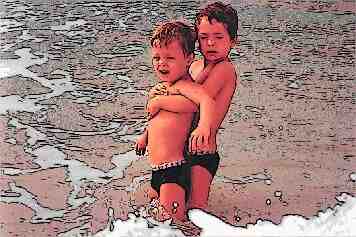
Normally, the images of the short stories online correspond to the characters or elements of the true stories. The images of the story are photos although on occasions these are altered so that they look like drawings.

In the true story of this moral story the two boys refused systematically to put away any toys; in a way, they had decided to oppose themselves radically to the idea or obligation to put away toys.
When children are very small I consider that it is better to not impose the putting away of toys, because for them it could be a great effort and it could mean a disincentive for particular games. However, as they grow one has to start incorporating the idea of putting away toys and, logically, the first step is not to make a mess of the toys if they aren’t going to play with them for more than 10 seconds. That’s where the little battle started that finished with the short moral story of Long-Legs and Short-Legs!
In the tales based on true stories it is a good idea to perform the contrary process used on the personalized tales.
Little children feel strong and clever when they understand the messages and the relations between the story and the real world. For that opportunity that they are offered by these stories about life they feel grateful and they have a natural tendency to return the favor by accepting the moral of the story, if it is reasonable, of course.
The image of the boys in the waves is not directly related to the moral story but it is nice and it can illustrate what happens to children who don’t put away their toys.
LONG-LEGS AND SHORT-LEGS
Once upon a time, in the heart of Africa, in the Savannah,
there lived an ostrich called Avestruz,
and he had two little sons,
one had very long legs and the other one very short ones,
and they were called Long-Legs and Short-Legs.
Also, to look after their home, he had an ostrich called Uuz.

Every day, Daddy Av... would tell the little ostriches
that they had to tidy up all their toys,
because, if not, one day the little elephant Fante would come
and take them all to his house.
L...-Legs and Sh...-Legs didn’t believe it
and they were very lazy
and they didn’t take any notice of their Daddy.
Until one day, when everyone was sleeping,
little F..., who was very naughty,
came to see if there were any toys he could take home,
and, because he was so playful, he took all of them.
The next morning, when L...-Legs and Sh...-Legs woke up,
they looked for the toys, and, when they didn’t find them,
they ran to wake up their Daddy, Avestruz,
who had his head hidden in the sand
(Because that’s how ostriches sleep).
When they managed to wake him up,
they told him they couldn’t find the toys.
Avestruz answered them: I had warned you, but don’t worry,
I’ll go and speak with little F...
to ask him if he has them,
and then, because he is so proud,
I am going to tell him that I’ll race him,
and that if I win, he has to give them back.
And so they raced, to see who could go
to a tree that was in the distance,
turned around and come back first.
And do you know who one? Avestruz.
And do you know why? Because even though little F... ran very fast,
Daddy A... was the ostrich with the longest legs of all the ostriches
and he was very strong and powerful.
And so, little F... gave them back all their toys
and also two little wooden elephants, one with very long legs
and the other with very short legs.
And the little ostriches, from that day on,
always tidied up all their toys before going to bed.
And everyone was happy, and they all ate worms
and big eggs,
and now...
SLEEP